These lost meditation techniques have been waiting for you. Not in the way that a wellness app notification waits — gently pinging until you dismiss it. More like the way a seed waits underground. Patient. Intact. Ready to crack open the moment it finds the right conditions. We talk about meditation endlessly in the modern world. Breathe for four counts, hold for four, release for four. Download this app, follow this teacher, attend this retreat. There is genuine value in all of that. But somewhere along the way, we lost the thread connecting us to practices that are older, stranger, and in many ways far more powerful than anything currently being marketed to us.
These are not beginner techniques. They weren’t designed for stressed-out professionals trying to squeeze five minutes of calm between meetings — though they can serve that purpose too. They were developed by monks, mystics, shamans, and desert hermits who gave their entire lives to the study of inner experience. People who treated the mind the way a master craftsman treats raw material — with patience, precision, and a kind of reverence most of us have never applied to our own inner lives. Across seven ancient civilizations, these lost meditation techniques quietly shaped entire spiritual traditions. Some survived in fragments. Some were nearly erased. All of them still work.
Let’s begin.
1. Trataka — The Indian Art of Flame Gazing
Origin: Ancient India (Hatha Yoga)
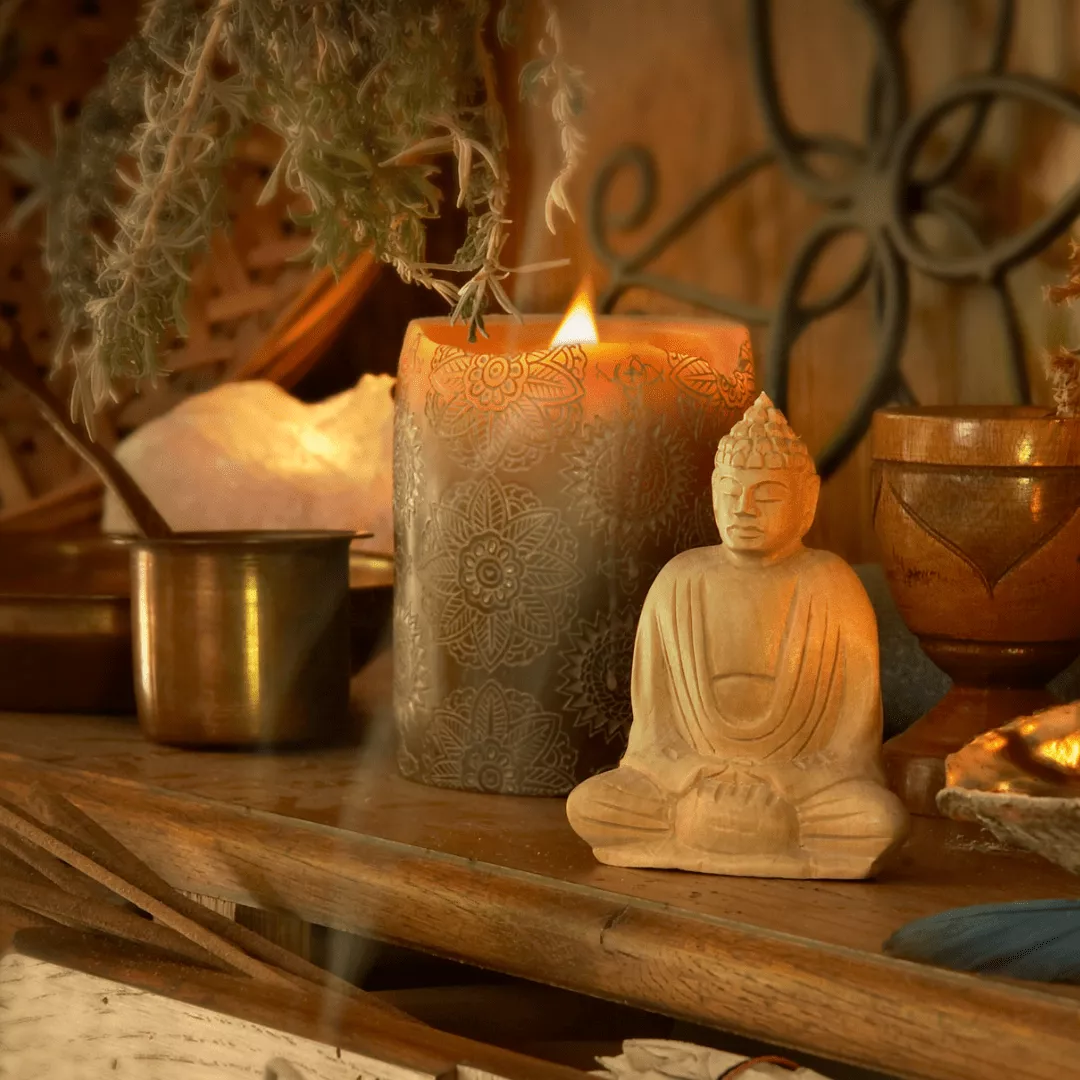
There is something that happens when you stare at a candle flame without blinking. At first, it feels like nothing. Then your eyes start to water. Then — if you stay — something in the mind goes very, very quiet.
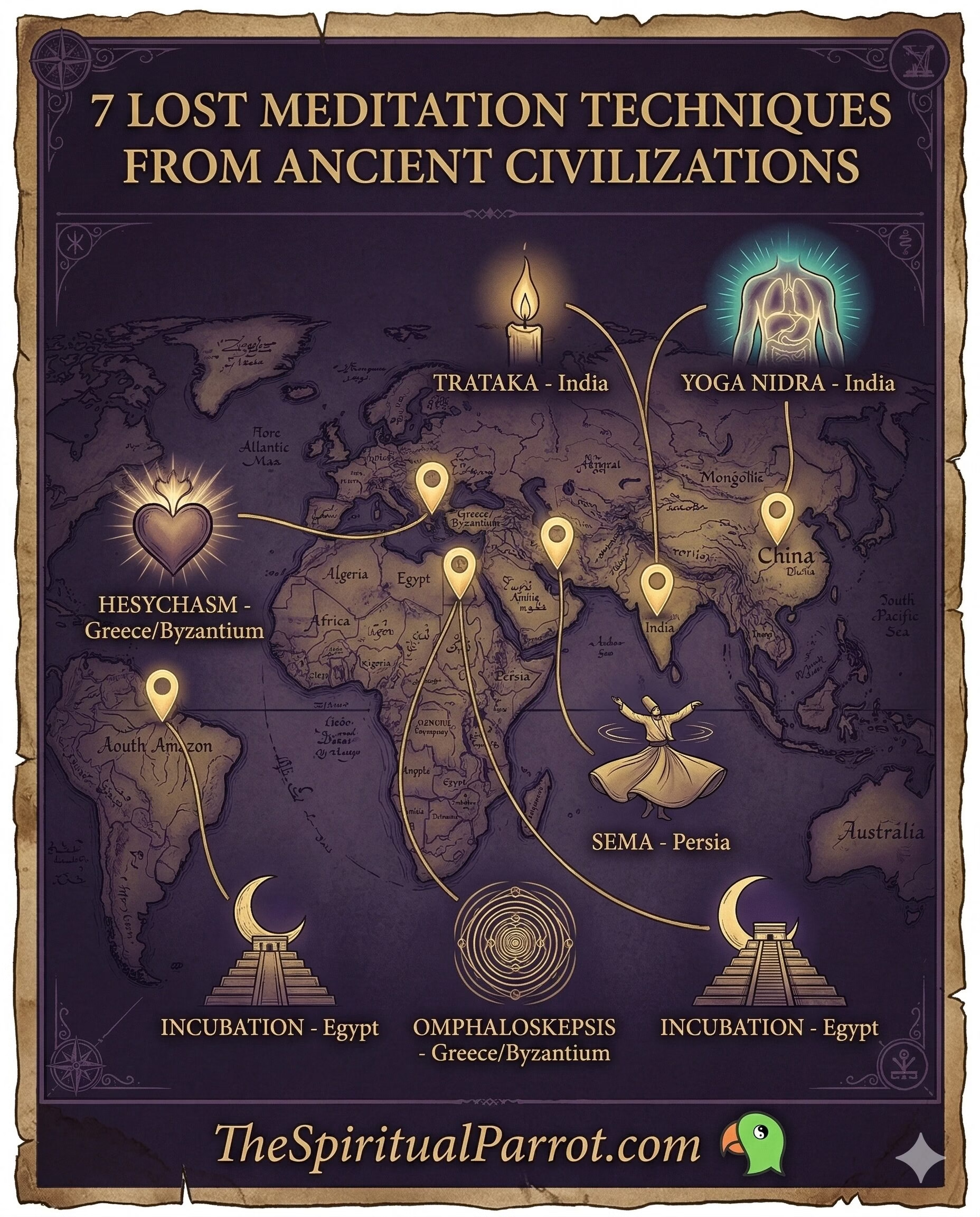
Trataka is one of the six purification practices described in the Hatha Yoga Pradipika, written in 15th-century India but encoding teachings far older. The word itself comes from Sanskrit and means simply “to gaze.” Ancient yogis used it as an entry point into states of concentration so deep that ordinary thought lost its grip entirely.
The practice works on multiple levels at once. Physiologically, sustained unblinking focus activates the optic nerve in ways that trigger parasympathetic nervous system dominance — the state associated with deep rest and stillness. Energetically, yogic texts teach that the flame is not merely a physical object but a representation of the inner light at the center of consciousness. Gazing at the outer flame trains the practitioner to eventually perceive the inner one.
There are two forms. External Trataka involves gazing at the flame itself. Internal Trataka involves holding the afterimage of the flame in the mind’s eye after closing the eyes. Advanced practitioners work with both in sequence, using the transition between outer and inner as a doorway.
How to Practice Trataka
Sit comfortably in a darkened room. Place a candle at eye level about two feet away. Gaze at the tip of the flame with soft, unblinking eyes. When tears come, gently close your eyes and hold the image of the flame at the space between your eyebrows. When the image fades, open your eyes and begin again. Start with five minutes and extend gradually.
What makes Trataka so remarkable among the lost meditation techniques of ancient India is how accessible it remains. You need nothing but a candle and the willingness to be still.
2. Yoga Nidra — Conscious Sleep from the Tantric Tradition
Origin: Ancient India (Tantric texts)
Sleep and meditation are usually treated as opposites. Yoga Nidra collapses that distinction entirely.
Rooted in the Tantric scriptures of ancient India — particularly the Mandukya Upanishad, which maps the four states of consciousness — Yoga Nidra guides the practitioner into the hypnagogic threshold: that precise borderland between waking and sleep where the logical mind softens its grip and the deeper psyche becomes accessible.
It is sometimes translated as “yogic sleep,” but that phrase undersells it considerably. What Yoga Nidra actually does is maintain a thread of conscious awareness through states that are normally experienced in total unconsciousness. You are awake inside what the body experiences as sleep.
Ancient teachers taught that the real gift of this practice is not rest — it is access. At the threshold between waking and sleep, the subconscious mind is open in a way it rarely is during ordinary waking life. Practitioners plant a Sankalpa — a deeply held intention — at this precise moment. Unlike affirmations repeated in a fully conscious state, a Sankalpa planted in Yoga Nidra bypasses the rational mind’s habit of arguing with everything and lands in far more fertile ground.
How to Practice Yoga Nidra
Lie flat on your back. Systematically move your awareness through each body part in a specific sequence — right hand thumb, index finger, middle finger, continuing through the whole body. The sequence keeps the mind engaged enough to stay conscious while the body releases completely. State your Sankalpa once before you begin and once more just before you emerge.
Among the lost meditation techniques in this list, Yoga Nidra may have the lowest barrier to entry and the deepest long-term payoff.
3. Nei Guan — Taoist Inner Observation
Origin: Ancient China (Taoist tradition)
In the West, introspection usually means thinking about yourself. In the ancient Taoist tradition of China, it meant something completely different.
Nei Guan (内观) translates as “inner observation” or “inner seeing.” It appears in classical Taoist texts including the Huangting Jing — the Yellow Court Classic — which dates to at least the Han dynasty and likely preserves far older material. Nei Guan was practiced by Taoist adepts who believed the body was not merely flesh and bone but a living landscape inhabited by subtle energies and intelligences.
The practice itself is deceptively simple: you sit in stillness and tour the interior of your body with your attention. Not analyzing what you find. Not trying to fix or improve anything. Just watching.
Moving from organ to organ, the practitioner senses the quality of energy within each area — warmth or coldness, contraction or expansion, ease or resistance. Over time, this kind of sustained inner witnessing develops what Taoist teachers called “inner vision” — the ability to perceive the body’s subtle energetic landscape with something approaching clarity.
What distinguishes Nei Guan from ordinary body scanning is its relational quality. Ancient practitioners spoke to the organs. They expressed gratitude. They listened for responses. The liver was not merely a filtering organ — it was a living intelligence. The heart was not just a pump — it was the seat of spirit (Shen), and it responded to attention the way a shy animal responds to patience.
How to Practice Nei Guan
Sit quietly with your eyes closed. Begin at the crown of your head and slowly draw your attention downward — scalp, forehead, eyes, throat, chest. At each region, pause. Notice without commentary. At the heart center, rest for longer. Ask quietly: what is present here right now? One full inner tour takes about twenty minutes when done slowly.
As one of the more overlooked lost meditation techniques, Nei Guan offers something most modern mindfulness practices skip entirely: genuine intimacy with your own interior life.
4. Hesychasm — The Heart Prayer of Byzantine Mystics
Origin: Early Christianity, Byzantine Greece
This one surprises people, because it comes not from the East but from early Christianity.
Hesychasm — from the Greek hesychia, meaning “stillness” or “sacred silence” — developed among the Desert Fathers of Egypt and Syria in the third and fourth centuries CE. It was later refined by the monks of Mount Athos in Greece into one of the most complete meditative systems in any religious tradition.
The central practice is the continuous repetition of the Jesus Prayer: “Lord Jesus Christ, Son of God, have mercy on me.” But this description makes it sound far simpler than it is. Hesychast monks spent years learning to synchronize this prayer with their breathing, and then — through a process they described as bringing the mind into the heart — to relocate the center of awareness from the head down into the chest itself.

This wasn’t metaphorical. Practitioners described a felt, physical shift in the center of consciousness from the thinking mind to the heart. What awaited them there, according to accounts documented from the fourth century onward, was something they called the Uncreated Light — a direct experience of divine luminosity they carefully distinguished from anything imagined or visualized. This was not something they constructed. It was something they encountered.
Modern scholars studying Hesychast accounts have noted striking parallels with descriptions in Tibetan Dzogchen, Sufi mysticism, and Hindu accounts of Atman. Different maps. Same territory.
Adapting Hesychasm for Your Practice
Choose a short sacred phrase that carries genuine meaning for you. Sit quietly and begin repeating it slowly — not as a thought but as a breath. Let it descend. If your awareness tends to live in your head, consciously bring it down into your chest. Rest your attention there. Let the phrase grow quieter and quieter until it becomes almost like a pulse — present, but barely audible.
Among the lost meditation techniques explored in this article, Hesychasm may be the most complete as a standalone spiritual path.
5. Sema — The Sacred Whirling of the Sufi Dervishes
Origin: 13th-century Persia (Mevlevi Sufi order)
Most people file Sema under “beautiful cultural performance.” That categorization misses the point almost entirely.
Sema is the sacred ceremony of the Mevlevi order — the Sufi brotherhood founded by followers of the poet-mystic Rumi in 13th-century Persia. The name comes from the Arabic for “listening” — specifically, listening to divine music with the whole body. The whirling is not the point. It is the method.
Every element of the ceremony carries symbolic precision. The practitioner’s tall felt hat represents the gravestone of the ego. The white robe is the ego’s burial shroud. As the dervish turns, the right hand is raised palm-up to receive divine grace from above; the left hand faces the earth to transmit that grace below. The dervish becomes a channel — heaven flowing through them into the world.
What makes Sema function as genuine meditation, rather than devotional theater, is what happens when sustained spinning overwhelms the vestibular system. Spatial orientation dissolves. Thought patterns tied to ordinary selfhood lose their footing. Experienced practitioners describe entering a state that holds profound emptiness and unconditional love simultaneously — not alternating between the two, but both present at once.
This is not a state you can think your way into. It requires the body’s full participation, which is precisely the point.
How to Explore Sema-Inspired Meditation
Stand in an open space. Close your eyes. Begin turning slowly, arms at your sides. Let the movement be continuous. Focus attention at your heart center. After a few minutes, extend your arms — right palm up, left palm facing down. Let the turning become effortless. Notice what begins to shift in the mind when the body is fully committed to the practice.
6. Omphaloskepsis — Navel Meditation of Ancient Greece
Origin: Ancient Greece (Stoic & Pythagorean schools)
This one has been turned into a punchline. “Contemplating your navel” is shorthand in modern culture for pointless self-absorption — which tells you exactly how thoroughly the original practice was buried.
Omphaloskepsis — from the Greek omphalos (navel) and skepsis (examination) — was practiced by certain ancient Greek philosophical schools as a legitimate meditative technique. The navel was understood as the body’s physical center, but also as a symbolic threshold: the point where the individual had once been connected to the source of life. Contemplating it was a way of returning attention to origin — to what existed before thought, identity, and opinion cluttered the mind.
In some versions of the practice, navel focus was paired with breath retention and specific postures designed to gather awareness toward the body’s center of gravity. The goal was a state the Greeks called ataraxia — profound mental tranquility, free from disturbance — which certain philosophers considered the highest form of happiness available to a human being.

The Stoics, the Epicureans, and certain Pythagorean communities all practiced forms of inner-directed contemplation, though they rarely used the vocabulary we associate with Eastern traditions. What they shared was the conviction that the untrained mind exists in constant agitation, and that deliberate attention — turned inward, anchored to the body — was the only reliable antidote.
How to Practice Omphaloskepsis
Sit comfortably. Direct your inner attention toward your navel with your eyes gently closed. Breathe naturally. Each time the mind drifts into thought, gently return to this point. Notice the rise and fall of the belly. Stay with the physical center rather than the thinking periphery. Practice for ten to twenty minutes.
Simple. Easy to dismiss. Quietly effective. That’s often the mark of the most durable lost meditation techniques.
7. Temple Incubation — Sacred Dream Meditation of Ancient Egypt
Origin: Ancient Egypt & Greece
Of all the lost meditation techniques on this list, this one requires the most significant shift in how we think about what meditation is actually for.
In ancient Egypt and later in the Greek sanctuaries of the healing god Asclepius, there existed a formalized practice called Incubation — from the Latin incubare, meaning “to lie upon.” Seekers who required healing, guidance, or divine contact would travel days to a sacred temple, undergo ritual purification over several days — fasting, bathing, prayer, specific herbal preparations — and then sleep within the consecrated inner chamber, directly on sacred ground.
The dream received in that space was not considered an ordinary dream. It was understood as a direct communication from the divine — a message from an ancestor, a visit from the temple deity, or a revelation from the deepest layer of the dreamer’s own soul. Egyptian dream papyri describe the use of blue lotus and kyphi incense — a complex blend including cassia, frankincense, and myrrh — to deepen the dreamer’s receptivity.
What makes this one of the most quietly radical lost meditation techniques is its underlying premise: that sleep itself, properly prepared for, is a meditative state. That the dream is not noise to be filtered out but signal to be cultivated. That the boundary between what we receive in waking and what we receive in sleep is more permeable than we assume.
Creating Your Own Incubation Practice
- In the days before you try this, reduce screen time before bed and eat lightly in the evenings.
- On the night of the practice, cleanse your bedroom space with sage, palo santo, or whatever clearing method resonates with you.
- Place a crystal beside the bed — amethyst or selenite are traditional choices in crystal work.
- Write one clear, heartfelt question in a journal before lying down. Speak it aloud once. Then let it go.
- Upon waking, write everything you remember before checking your phone, before speaking, before getting up if possible.
The ancients believed the moments immediately after waking were still within the dream’s field. Don’t let them collapse before you record what came.
Bringing These Lost Meditation Techniques Into Your Life
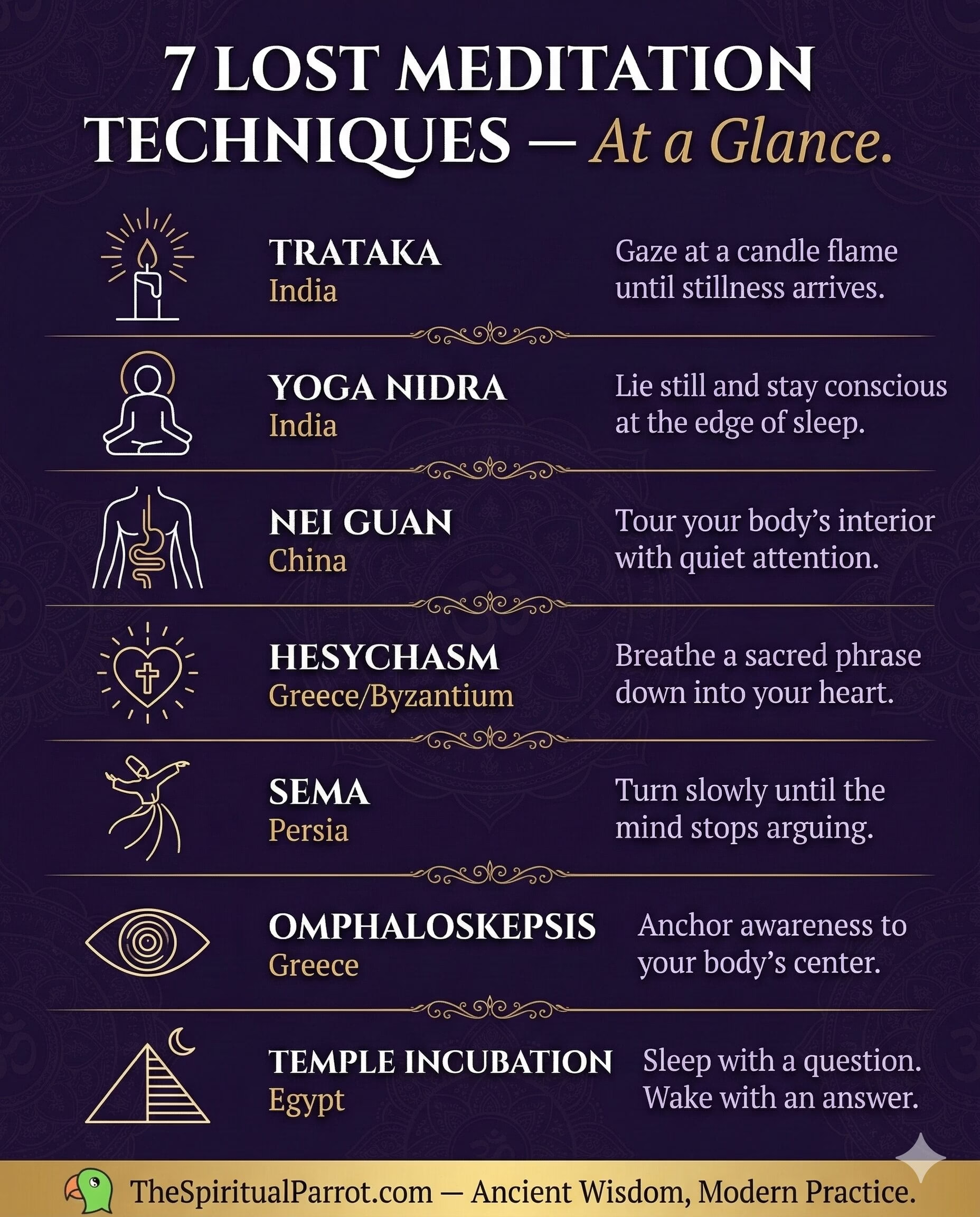
What’s striking about these lost meditation techniques — taken together — is how different they are from each other. One uses fire. One uses spinning. One uses sleep. One draws awareness to the body’s physical center. One moves consciousness from the head into the heart. They don’t look like the same practice. They don’t feel like the same practice.
And yet they point toward the same place.
Every single one of these practices, in its own way, is trying to interrupt the mind’s default relationship with itself. That restless, commentating, planning, remembering, comparing activity that we call “thinking” — which is, in many ways, just the mind’s habit of avoiding stillness. These traditions understood — with a clarity we are only beginning to recover through neuroscience — that the thinking mind is not the whole of what we are. Beneath it, or woven through it, there is something quieter. More stable. Vastly more intelligent. Every culture that developed meditative practices had its own name for it. The Atman. The Tao. The heart of hearts. The Uncreated Light.
These lost meditation techniques are not relics. They are invitations — each one a slightly different doorway into the same interior country. You don’t need to commit to any single tradition. Start with one practice that genuinely interests you. Give it two weeks of consistent daily effort — even ten minutes a day. Notice what changes. Let your experience guide the next step.
The thread is still there. All you have to do is pick it up. Which of these lost meditation techniques calls to you? Share in the comments — we’d love to know where your practice is taking you.