You or someone you love was born with a strawberry birthmark. And at some point, probably more than once, the question arrived: what does it mean?
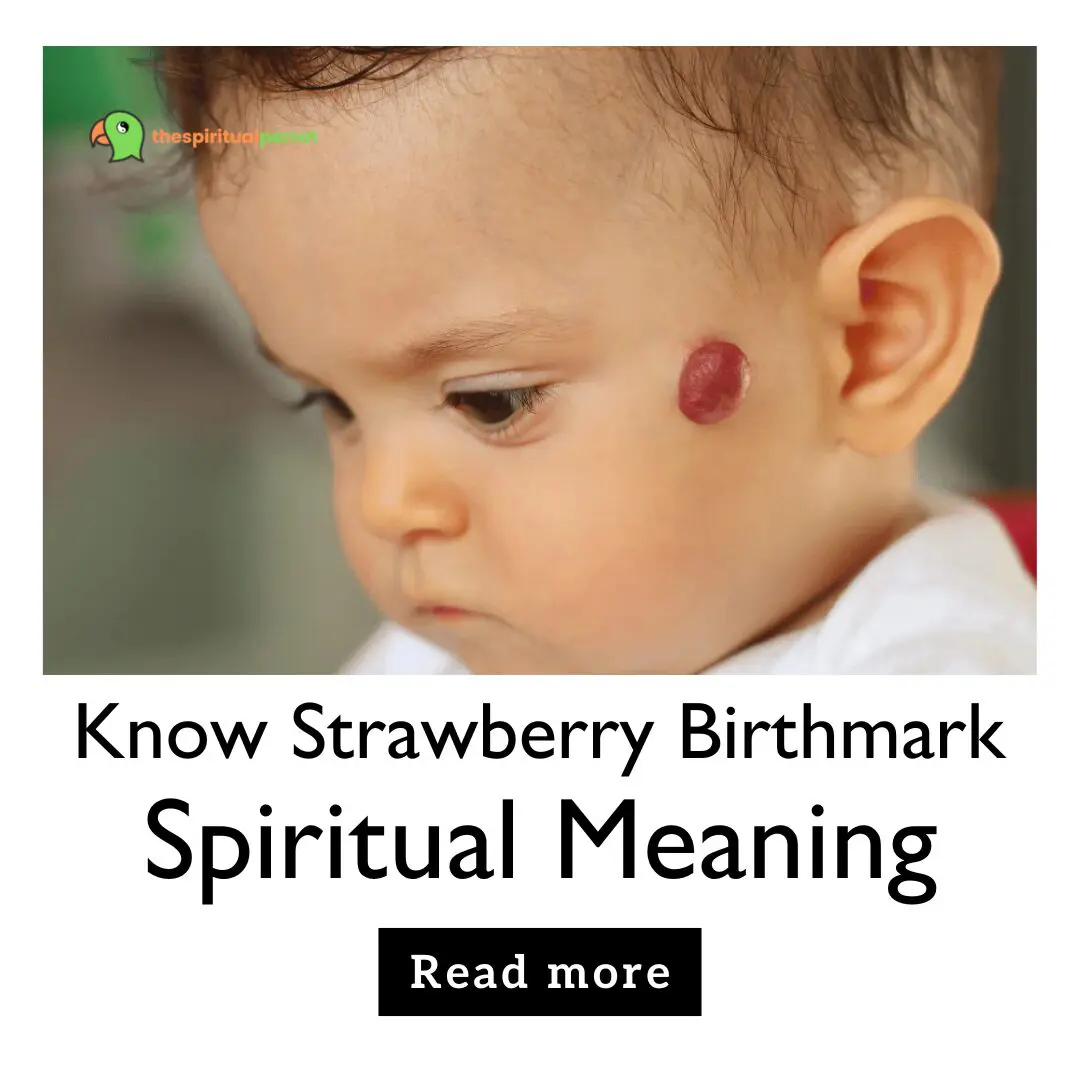
Not medically. Medically it’s a hemangioma — a cluster of blood vessels near the surface of the skin that forms in early infancy, grows for a while, then gradually fades. Most are gone by age ten. The medical explanation is clear enough.
But that’s not why you’re here.
The spiritual question is older than medicine and comes from a simpler observation: these marks appear on specific people, in specific places, in a specific vivid red. Across cultures and centuries, people noticed that pattern and built meaning around it. Some of those meanings are quite beautiful. Some are genuinely thought-provoking. And a few — like the researcher who spent his career documenting children who remembered their past lives through their birthmarks — are harder to dismiss than you might expect.
Here’s what we know, from folklore, spiritual traditions, and one corner of academic research that rarely gets cited in articles like this.
What is a strawberry birthmark, exactly?
Before the spiritual meanings, the physical reality — because understanding what this mark actually is adds something to the spiritual interpretation.
A strawberry birthmark (medically: a superficial infantile hemangioma) is a raised, bright red mark caused by an overgrowth of blood vessels just under the skin. Unlike port-wine stains or flat birthmarks, hemangiomas aren’t usually present at birth. They appear in the first few weeks of life, grow quickly during the first year, then slow down. Most fade significantly between ages three and seven, with many disappearing almost completely by age ten.
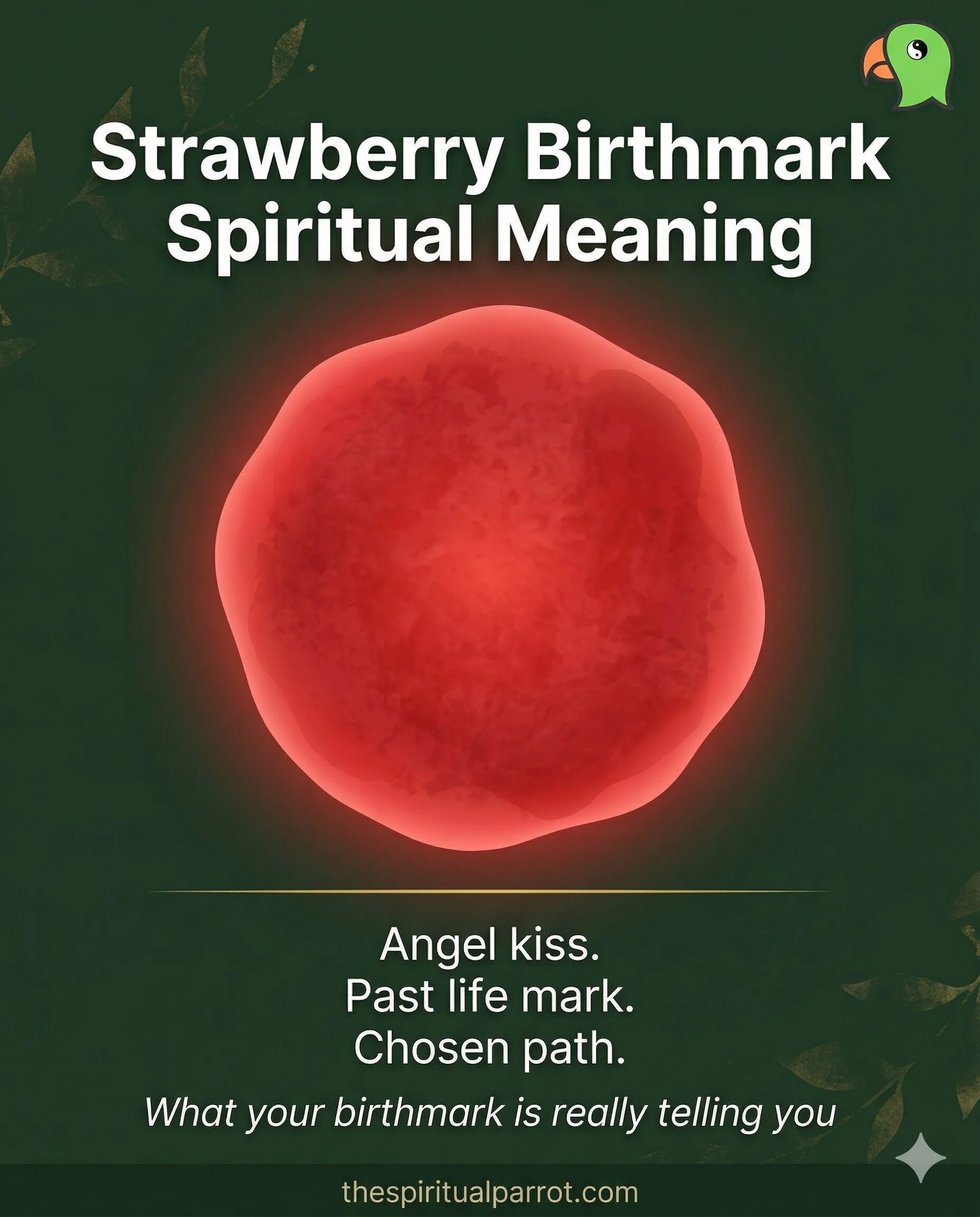
That developmental arc matters spiritually. This isn’t a static mark. It arrives, intensifies, then releases. Many spiritual traditions read that pattern as intentional — a message that was needed for a season, delivered, and then allowed to dissolve.
Roughly one in ten babies develops a hemangioma. Girls get them about three times more often than boys. Premature babies are more likely to have them. They appear most commonly on the head, neck, and face — the most visible, most socially exposed parts of the body. Whether that distribution is medically random or spiritually deliberate depends on what you believe. But it’s worth noting.
9 spiritual meanings of a strawberry birthmark
1. An angel kiss
The most widely known interpretation — and the one parents reach for most naturally — is that strawberry marks on the face or head are angel kisses. The mark, in this reading, is a trace of where a guardian angel touched the child before birth, claiming them and placing them under particular care.
It’s a tender interpretation, and not without logic. The face and head are where hemangiomas appear most often. These are also the most personally identifying parts of a person. A mark there, in vivid red, has always attracted attention — and the angel kiss story gives that attention a warm frame rather than a stigmatising one.
Different cultures call this different things. In parts of Europe it’s an angel’s touch. In Scandinavian folklore the mark is where a fairy blessed the child. In some Latin American traditions the red mark is a kiss from a loved one who passed before the baby arrived.
2. Protection from spiritual harm
Red has been a protective colour in spiritual traditions across the world for thousands of years. Red thread in Jewish and Kabbalistic tradition wards off the evil eye. Red doors in Chinese culture block negative energy. Red ochre markings in indigenous traditions carry protective power.
A strawberry birthmark — vivid, red, appearing on the body of a vulnerable new life — fits naturally into this framework. Many traditions hold that a person born with one carries an extra layer of spiritual protection. The mark is a shield, absorbing negative energy before it reaches the person it covers.
This meaning is especially associated with marks on the back of the neck (stork bites) and on the scalp, where the mark is hidden from view but physically close to the most spiritually sensitive parts of the body — the crown and the base of the skull.
3. A past life imprint
This is the interpretation with the most unusual academic backing.
Dr. Ian Stevenson, a psychiatrist at the University of Virginia, spent decades documenting cases of children who claimed to remember past lives. His research, collected in books including Where Reincarnation and Biology Intersect, found that a significant number of these children had birthmarks that corresponded to injuries or wounds their claimed past-life identities had sustained. A child who said they had been shot would have a round birthmark at the entry point. A child who described a blade wound had a mark along the corresponding scar line.
Stevenson was not a fringe figure. He was a department chair at a research university, and his methodology — interviewing families independently and cross-referencing claims with medical records — was careful. You can disagree with his conclusions. But his research is harder to wave away than most past-life material.
In this framework, a strawberry birthmark isn’t just a vascular anomaly. It’s where something happened before. The location carries the memory the soul brought forward.
4. A marker of healing ability
Several traditions — Native American among them — associate red birthmarks with healing gifts. The person marked in red is seen as someone whose life will involve healing others, whether as a caregiver, a counsellor, a healer in the traditional sense, or simply someone who shows up in other people’s hardest moments.
The reasoning connects to the colour. Red is the colour of blood, of life force, of the root chakra — the energy centre associated with survival, groundedness, and physical vitality. A person marked at birth with this colour is thought to carry an excess of that vital energy, enough to share.
Parents who hold this interpretation often notice that children with these marks do develop early sensitivity to others’ pain. Whether that’s the mark’s influence or confirmation bias is impossible to say with certainty. But the tradition is old enough to be worth noting.
5. A sign of a chosen path
Across multiple spiritual traditions — including certain Christian, Hindu, and indigenous interpretations — birthmarks are understood as divine markings. Not decorative. Intentional. The person was marked before birth for a specific purpose, and the mark is the outward evidence of that designation.
In this reading, a strawberry birthmark doesn’t prescribe what the purpose is. It says one exists. The person’s life will involve something they were specifically placed here to do. The mark is a reminder, not a map.
Some people find this interpretation useful not as literal theology but as a personal framework. It reframes the birthmark from anomaly to identifier. You weren’t marked randomly. You were marked.
6. Unfinished business from a previous life
This interpretation is close to but distinct from the past-life wound theory. Where the wound theory focuses on physical trauma carried forward, the unfinished business interpretation is broader. The mark indicates that something wasn’t completed — a relationship, a lesson, a responsibility — and this life is the continuation of that work.
In Hindu and Buddhist frameworks, this falls within the general understanding of karma: not as punishment, but as the soul’s curriculum. What wasn’t resolved carries forward until it is. The birthmark is a physical reminder that the curriculum is ongoing.
People drawn to this interpretation often find it useful for making sense of life patterns that feel older than their current circumstances. A pull toward a particular place, a person who feels inexplicably familiar, a deep passion for something with no obvious origin in this life — these are sometimes understood as threads from the unfinished chapter the mark is referencing.
7. Connection to a loved one who passed
This meaning is particularly common in cultures where ancestor connection is central to spiritual life. The birthmark, in these traditions, is where a grandmother, an ancestor, a beloved person who died before the child was born, made contact. The child arrives carrying the touch of someone the family already knows and loved.
This interpretation gains particular weight when the birthmark resembles or appears in the same location as a mole, scar, or mark that a deceased family member had. This is documented enough that Stevenson included family recognition of marks in his research methodology.
Whatever the mechanism — spiritual, genetic, coincidence — the comfort of this reading is real. A mark that might otherwise feel strange becomes a form of connection to lineage.
8. Heightened intuition and spiritual sensitivity
Some traditions, particularly those in Eastern European and Romani folk belief, associate red birthmarks on the face and head with psychic sensitivity. The person sees and feels things others miss. They pick up on atmospheres in rooms. They sense when something is wrong before there’s visible evidence.
This isn’t presented as a superpower in these traditions so much as a characteristic that requires management. Sensitivity without grounding is overwhelming. The birthmark is an indication of a particular kind of awareness, not an endorsement of it.
Whether or not you accept the psychic framing, there’s something interesting in the observation that people with visible birthmarks on the face often develop heightened social awareness early. Being noticed — and sometimes stared at — from infancy produces a particular attunement to how others are responding to you.
9. Abundance, sweetness, and the good life
The simplest interpretation, and in some ways the most generous one. Strawberries are symbols of sweetness, summer, abundance, and sensory pleasure in folk traditions across Europe and the Americas. A strawberry-coloured mark was, in many of these traditions, a straightforwardly good omen. The child would know abundance. Life would be sweet. They carried the colour of good things.
This interpretation appears most often in the folklore of countries where strawberries grow wild and were historically associated with luck and the arrival of summer. It’s less philosophically complex than the past-life theories. But it’s also the most immediately comforting, and sometimes that’s what a meaning needs to be.
Strawberry birthmark meaning by location on the body
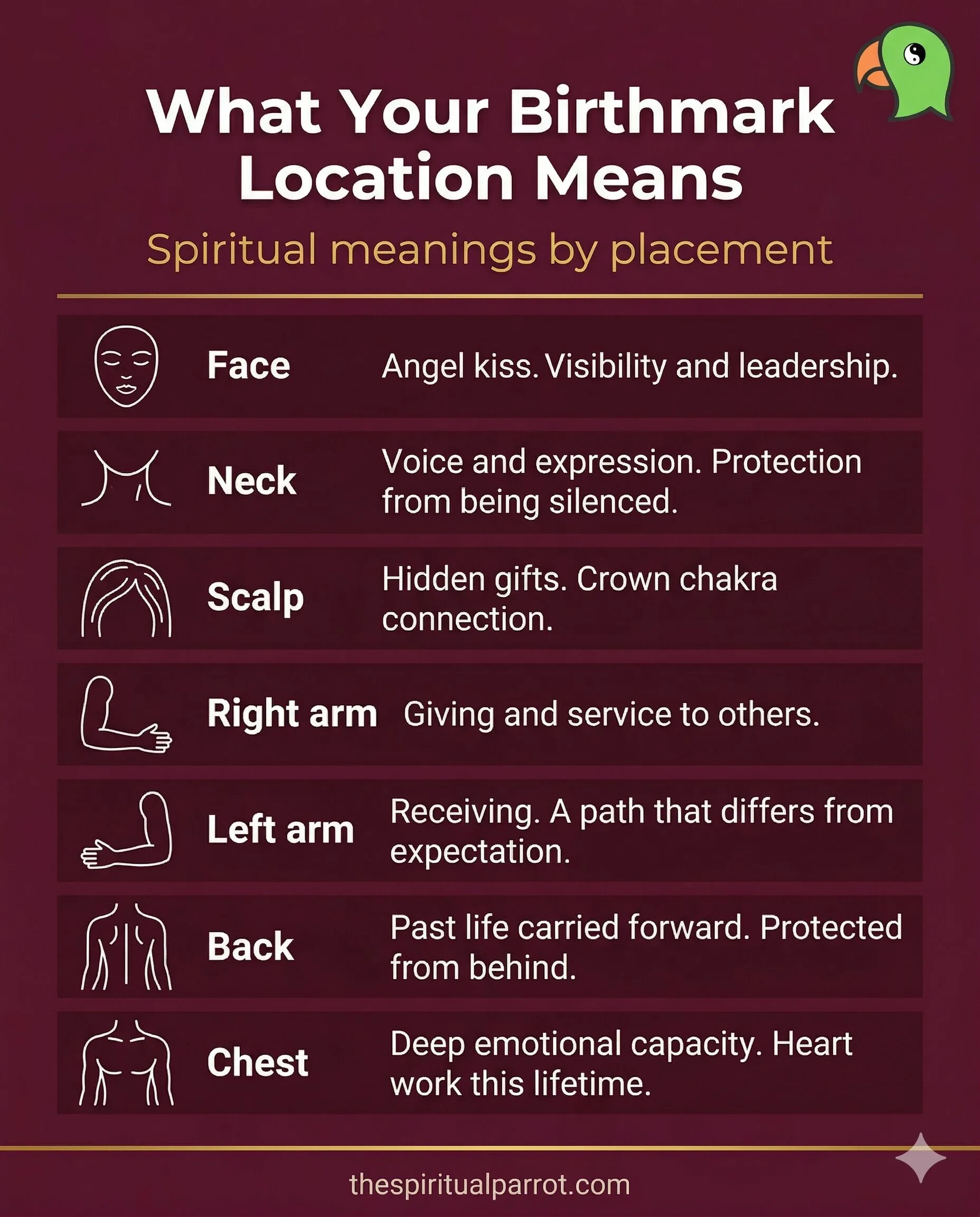
Location matters in almost every spiritual tradition’s approach to birthmarks. Here’s what different placements are thought to indicate.
Strawberry birthmark on the face
Face birthmarks, in most traditions, are the most significant. The face is identity. It’s the part of you others see first. A mark there is public, unavoidable, and impossible to ignore in social settings.
Spiritually, a face birthmark is often read as a signal of a life that will involve being seen — in leadership, public service, creative work, or community. The person isn’t meant to stay in the background. The mark on their most visible surface is a kind of instruction.
The angel kiss interpretation is most commonly applied to marks on the cheek, forehead, or eyelid. Marks near the eyes specifically are sometimes associated with spiritual sight — the ability to perceive what others miss.
Strawberry birthmark on the neck (stork bite)
Neck marks, often called stork bites, are among the most common hemangioma locations. The neck connects head to body — intuition to action, thought to expression. Spiritually, a mark here often relates to communication: the person has something important to say, and the mark is at the place where that expression passes through.
Some traditions read neck birthmarks as protection against being silenced — the person will find their voice even if circumstances try to prevent it. Others see it as a straightforward blessing of eloquence and truth-telling.
Strawberry birthmark on the scalp or back of the head
Hidden marks — ones covered by hair or in locations rarely seen — carry a different quality than visible ones. Where a face birthmark announces itself, a scalp mark is private. Known only to the person and those close enough to see it.
Spiritually, hidden marks are often associated with inner gifts rather than external roles. A mark on the crown of the head is connected to the crown chakra — spiritual connection, higher consciousness, openness to guidance. The person carries this capacity quietly, without displaying it.
Strawberry birthmark on the arm
Arms in spiritual symbolism are about action, giving, and reaching. A birthmark on the right arm is often associated with giving — generosity, service, offering something to the world. A mark on the left arm points toward receiving — the person is meant to accept help, love, and abundance rather than constantly extending outward.
Some traditions read arm marks more specifically around the idea of work and purpose. What the marked arm does in the world is the work this person came to do.
Strawberry birthmark on the back
Back birthmarks, in several traditions, are connected to past life injuries or burdens carried forward. The back bears weight. A mark there may indicate something the soul is still processing from a previous chapter.
There’s also an interpretation tied to protection: a mark on the back covers the one part of yourself you can’t see. Someone or something is watching what you can’t watch yourself.
Strawberry birthmark on the chest
Chest marks are close to the heart. In most spiritual readings this is the most emotionally significant placement. The person has a deep capacity for love, feels things intensely, and may have come into this life with specific emotional work to do — either healing past-life heartbreak or learning to give and receive love more freely than their soul has managed before.
Angel kiss vs stork bite: what’s the difference?
These two terms are used interchangeably in some contexts but they technically refer to different placements.
An angel kiss is a hemangioma on the face — usually the forehead, eyelid, nose, or cheek. The name captures the idea that an angel touched the child’s face before birth.
A stork bite is a similar mark on the back of the neck, the nape, or the back of the scalp. The folklore origin here is that a stork carried the baby and left a mark where it held the child in its beak — a somewhat stranger image, but one that carries warmth in the tradition that built it.
Spiritually, the distinction is mostly one of visibility. Angel kisses are seen. Stork bites are usually hidden under hair. Many traditions consider both to be protective marks, with angel kisses carrying more public or social significance and stork bites carrying a quieter, more private protection.
Cultural meanings across traditions
Native American traditions
In several Native American traditions, red birthmarks are associated with healing abilities and a strong connection to the natural world. The person is seen as someone with innate gifts for understanding plants, animals, and natural medicine. The red mark is a sign of the life force running strongly through them.
Chinese tradition
Chinese folk belief reads birthmarks as carrying information about past lives and future tendencies. A red birthmark is generally considered fortunate — tied to vitality, passion, and a life that will not be dull. Location matters considerably, with marks on the face often read as signs of public distinction and marks on the body as indicators of personality.
Indian tradition
In Hindu philosophy, birthmarks fit within the broader framework of karma and samsara. They’re understood as physical traces of past-life experience carried into the current incarnation. Specific marks are sometimes read by practitioners in the tradition of angavidya — the reading of bodily signs — for insight into what the soul is working through in this life.
European folklore
European folk traditions around birthmarks often centre on the mother’s experiences during pregnancy. A mother who craved strawberries and didn’t eat them might, in old belief, have a child born with a strawberry mark. This is medically unfounded, but the folklore reveals something about how these traditions understood the connection between desire, fulfilment, and the marks life leaves on us.
More contemporary European spiritual traditions tend toward the angel kiss interpretation, especially for marks on the face and head.
African traditions
In several African spiritual traditions, birthmarks are understood as ancestor markings — physical signs of connection to specific lineages or forebears. A red birthmark may indicate that the child carries the energy of a particular ancestor, or has been sent by that ancestor to continue work they left unfinished. This interpretation makes the birthmark a matter of family and lineage rather than solely individual spiritual destiny.
What does it mean when a strawberry birthmark fades?
This is one of the most searched questions around these marks, and almost nobody answers it well.
Hemangiomas fade. Most are significantly lighter by age five and nearly gone by ten. Medically, this is simply the blood vessels regressing. Spiritually, several traditions have interpretations for this process.
The most common reading is that the mark’s work is done. Whatever protection it provided, whatever message it carried, whatever karmic thread it was holding, has been sufficiently integrated. The soul no longer needs the physical reminder.
A second interpretation — particularly in traditions that associate the mark with a past-life wound — is that the fading signals healing. The wound has been acknowledged and processed enough to release. The scar from another life is resolving.
A third reading focuses on the developmental timing. Hemangiomas fade during the years when children are forming their core identity and beginning to understand themselves as separate from their parents. Some traditions see the fading as the mark completing its role as a protective layer during the most spiritually vulnerable period of early childhood, then stepping back as the child’s own awareness and strength develop.
What doesn’t mean anything significant, spiritually speaking, is if the mark fades quickly or slowly, or leaves a slight shadow versus disappearing completely. The overall arc of arrival, presence, and release is the message. The precise timeline is biology.
A note on accepting the mark
Whatever meaning you attach to a strawberry birthmark — or none at all — there’s something worth sitting with here.
These marks are highly visible in infancy and early childhood, exactly when a person is most influenced by how others respond to their appearance. Children with facial hemangiomas encounter stares, questions, and well-meaning but sometimes clumsy comments throughout those years. The spiritual traditions that call these marks angel kisses, divine protections, and signs of a chosen path are doing something practically useful: they give the child and the family a story about the mark that carries dignity.
That doesn’t require believing in past lives or guardian angels. It requires understanding that the story we tell about what we’re born with shapes, to a meaningful degree, how we carry it.
A child told they were kissed by an angel before they arrived grows up differently than a child told they have a skin anomaly. Both are technically accurate. Only one is useful.
Frequently asked questions
What is the spiritual meaning of a strawberry birthmark?
Across spiritual traditions, strawberry birthmarks are most commonly associated with protection (the mark as a spiritual shield), past life connections (the mark as a karmic imprint), healing ability (the red colour indicating strong life force energy), and divine designation (the person was marked before birth for a specific purpose). The specific meaning depends on the tradition and, significantly, where on the body the mark appears.
What does it mean to have a strawberry birthmark on your face?
Face birthmarks are generally considered the most significant in spiritual traditions. They’re connected to visibility, leadership, and being seen in the world. Angel kiss interpretations apply most commonly to facial marks, and some traditions associate marks near the eyes with heightened intuitive or spiritual perception.
Is a strawberry birthmark a sign of a past life?
Some traditions say yes. Dr. Ian Stevenson’s research at the University of Virginia documented children who described past life memories and had birthmarks that corresponded to wounds their claimed past-life identities sustained. His findings are among the most carefully documented in this area, though the interpretation remains contested. Whether you find that convincing depends on what you already believe about reincarnation.
What does it mean when a strawberry birthmark fades?
Most spiritual traditions read the fading as a sign the mark’s work is complete. The protection it provided has been received, the past-life wound it was marking has been processed, or the reminder it carried is no longer needed. The fading is understood as resolution rather than loss.
What is the difference between an angel kiss and a stork bite?
Angel kiss refers to a hemangioma on the face. Stork bite refers to the same type of mark on the back of the neck or scalp. Both are considered protective marks in folk traditions. Angel kisses carry more social and public significance in most readings; stork bites are associated with quieter, more private protection. Both are among the most common hemangioma locations.
What does a strawberry birthmark on a baby mean spiritually?
Most traditions read it as a blessing. The angel kiss interpretation is the most widely held, seeing the mark as where a guardian presence touched the child before birth. Other traditions see it as protective, as an ancestor’s signature, or as an indicator of particular gifts or a chosen path. The developmental arc of the mark — arriving, intensifying, then fading in early childhood — is sometimes read as a layer of spiritual protection that covers the most vulnerable period of a person’s early life.
The mark was there before you had words for it. The meanings came after. Both things can be true at once.