Quick Answer: The spiritual meaning of a snake in a dream depends entirely on the context: what the snake was doing, how you felt, and your waking life circumstances. Snakes are ancient symbols often used by the subconscious to grab your attention. A snake bite may signal a need to face something from your past or acknowledge ignored warning signs, while being chased by a snake often points to avoidance of a truth or necessary change.
Whatever the specifics, you opened your phone and typed some version of “what does it mean when you dream about snakes.” And now you’re here.I’m going to give you a real answer. Not a vague one about “transformation” repeated fifteen different ways with slightly different adjectives. I’ve spent years keeping a dream journal and studying how snake symbolism actually works across Hindu, Christian, Jungian, and Indigenous traditions. The meaning of your dream depends almost entirely on what the snake was doing, how you felt, and what’s going on in your waking life. So let’s get into the specifics.Why snakes keep showing up in dreams
Snakes are one of the oldest recorded dream symbols. Ancient Egyptians carved them into temple walls. The Buddha is depicted meditating behind a cobra. The Greek god of medicine, Asclepius, carried a staff with a snake wrapped around it, and that image still shows up on ambulances today.There’s a reason for all of this. Researchers believe humans evolved a hardwired sensitivity to snakes. Our brains are tuned to spot them faster than almost any other animal, even if we’ve never encountered one in real life. So when your subconscious needs to grab your attention in a dream, it often reaches for the snake.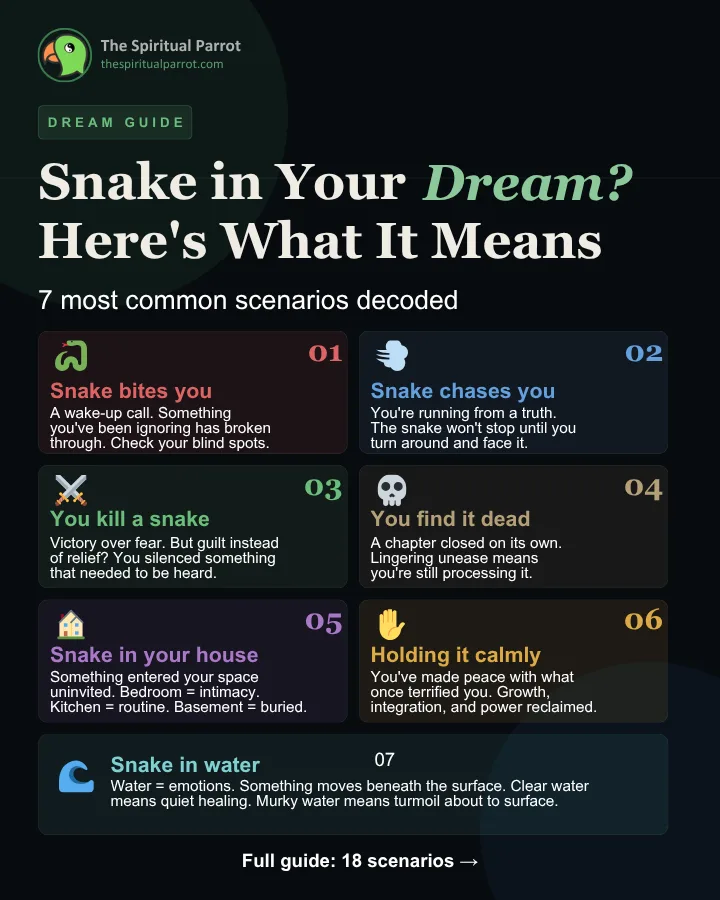 The spiritual meaning depends on context. A calm snake coiled near you is a completely different message than a snake striking at your face. Your personal relationship with snakes matters too. If you grew up terrified of them, the dream is more likely to be processing fear. If you find them beautiful, the dream may be pointing toward wisdom or power you haven’t tapped into yet.With that said, let me walk through the specific scenarios.
1. A snake bites you
Draw your tarot card of the day
One card from the full 78-card deck, as a prompt to carry through the next 24 hours. Draw your free card →
This is the dream that sends most people to Google at 3 AM. It feels like a warning, and in many spiritual traditions, it is one.In Hindu astrology, a snake bite dream is often connected to Rahu and Ketu, the shadow planets associated with karmic debt and past-life patterns. The bite can signal that something from your past is catching up with you, and you need to face it rather than avoid it. Some astrologers recommend Nag Dosha Nivaran Puja for people who have this dream repeatedly.In the Christian tradition, a snake bite echoes Genesis 3:15 and the ongoing tension between temptation and faith. The bite may represent a moment of spiritual vulnerability, a situation where your guard is down and something harmful has gotten through.From a Jungian perspective, the bite is your shadow getting your attention. Something you’ve been pushing away from your conscious mind has broken through. The pain in the dream is the pain of being forced to acknowledge what you’ve been avoiding.One card from the full 78-card deck, as a prompt to carry through the next 24 hours. Draw your free card →
The practical question to ask yourself: Is there a situation in your life where you’ve been ignoring warning signs? A relationship that feels off? A decision you keep postponing? The bite is often your subconscious saying “stop pretending this isn’t happening.”
Where the bite lands matters too. A bite on the hand can relate to work, creativity, or something you’re trying to hold onto. A bite on the foot or leg may point to your life direction, your path forward. A bite on the face is harder to ignore and may relate to identity or how others see you.2. A snake chases you
Being chased in a dream, by anything, usually points to avoidance. The snake just makes the message more specific.If you’re running from a snake, consider what you’re running from in waking life. It could be a confrontation, a truth about yourself, or a change you know needs to happen but feels overwhelming. Snakes are patient hunters. The dream may be telling you that whatever you’re avoiding isn’t going away just because you’re not looking at it.I’ve found that people who have this dream repeatedly tend to be dealing with something they already know about but haven’t acted on. A toxic workplace. A conversation with a partner that keeps getting postponed. A health concern they haven’t addressed. The snake chasing you is your own awareness, dressed in scales.3. You kill a snake
Most dream interpretation sites will tell you this is straightforwardly positive, a victory over obstacles. That’s half the picture.Yes, killing a snake in a dream can mean you’ve overcome something. In Hindu tradition, it often represents defeating an enemy or breaking free from negative patterns. In the Bible, it connects to the authority believers have over evil (Luke 10:19).But here’s the complication. In many Eastern traditions, killing a snake is inauspicious. Nagas are sacred in Hinduism, and killing one, even in a dream, can carry negative weight. Some Hindu communities treat this dream as a sign that a spiritual remedy (like visiting a Shiva temple or performing a snake-related puja) may be needed.There’s also the Jungian concern that killing the snake might mean you’re suppressing something rather than integrating it. If the snake represents a part of yourself, killing it in the dream could mean you’re refusing to acknowledge an instinct, desire, or truth that needs expression.The question isn’t just “did you kill the snake?” It’s “how did you feel afterward?” Relief suggests genuine resolution. Guilt or unease suggests you may have buried something that needed to be heard.4. You see a dead snake
A dead snake you didn’t kill is different from one you defeated. It usually signals that something difficult has run its course. A challenge, a fear, a period of turbulence. It’s done.If seeing the dead snake made you feel relieved, that’s a good sign. The problem has passed. If you felt uneasy looking at it, you may still be processing the aftermath of whatever the snake represented. The threat is gone, but the emotional residue hasn’t cleared yet.5. Multiple snakes
Dreaming of a pit or room full of snakes is overwhelming for a reason. It usually reflects feeling overwhelmed in waking life. Too many problems at once. Too many people pulling you in different directions. Too many fears stacking up.In Vedic astrology, multiple snakes can indicate that several karmic issues are active simultaneously. The dream isn’t necessarily negative, but it is asking you to prioritize. You can’t deal with everything at once. Pick the most pressing snake and handle it.The emotional texture matters here. If the snakes are calm, you may have more resources than you think. If they’re aggressive and closing in, the message is more urgent.6. A snake in your house
Your house in a dream usually represents your inner self, your psyche, your sense of safety. A snake inside that space means something has entered your personal domain that doesn’t usually belong there.This could be an external person or influence that’s disrupted your peace. It could also be an internal shift: a desire, fear, or realization that’s now impossible to ignore because it’s right there in your living room.Where in the house you find the snake adds nuance. In the bedroom, it may relate to intimacy or vulnerability. In the kitchen, it might connect to nourishment, family dynamics, or daily routines. In the basement, look at what you’ve stored away and forgotten about.7. Holding a snake without fear
This one is unusual and worth paying attention to. Most snake dreams carry some charge of fear or tension. If you’re holding a snake calmly, the dream suggests you’ve made peace with something that once scared you.Spiritually, this can indicate growth. You’ve integrated a shadow aspect of yourself. You’ve learned to work with a power you previously ran from. In the Kundalini tradition, this is sometimes interpreted as having reached a stage where primal energy is no longer something to fear but something you can direct.If you were struggling with the snake while holding it, the interpretation shifts. It may mean you’re trying to control something that isn’t fully yours to control, possibly an instinct, a relationship, or a life force that needs room to move.8. A snake talks to you
In dreams, when any animal speaks, it’s your deep psyche communicating something that your normal thinking mind can’t or won’t articulate. A speaking snake is particularly old as a symbol. The serpent in Genesis speaks. In Greek mythology, the Pythia at Delphi received her oracular power from a serpent. In Hindu tradition, Naga spirits communicate wisdom.Pay attention to what the snake says. Even if the words seem cryptic, write them down. Dream messages have a habit of making more sense a few days later when the situation they refer to becomes clear.9. A snake in water
Water in dreams represents emotion and the unconscious. A snake in water means something is moving through your emotional depths. It might be something you haven’t fully acknowledged yet, since it’s submerged. Or it could indicate that a transformation is happening at a level below your conscious awareness.Clear water with a calm snake is generally a positive sign: emotional healing is happening quietly. Murky water with an aggressive snake suggests emotional turmoil and unresolved feelings that may surface suddenly.10. Snake colors and what they mean
The color of the snake adds a layer of specificity to the dream. Here’s what different colors tend to point toward: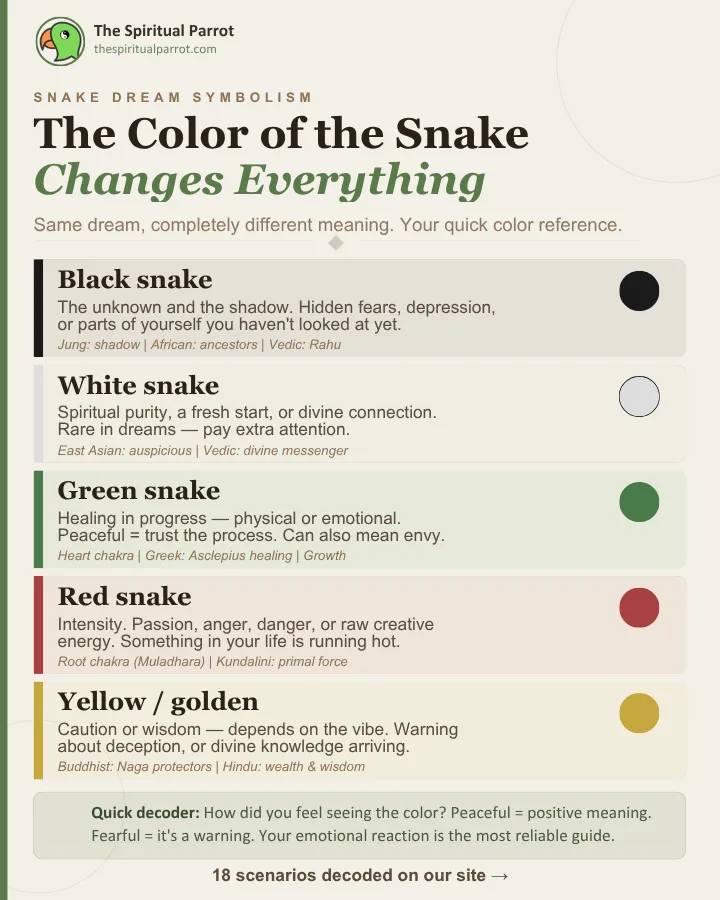
Black snake
Black connects to the unknown, the shadow, and things hidden from view. A black snake in a dream can indicate unconscious fears, depression, or hidden threats. In some African and Caribbean spiritual traditions, black snakes are associated with ancestral spirits. In Jungian terms, the black snake is the shadow itself, the parts of you that haven’t been brought into the light.White snake
White snakes are rare in nature and rare in dreams. When they appear, they often signal spiritual purity, a fresh start, or a connection to the divine. In East Asian traditions, a white snake is considered extremely auspicious. In dream psychology, white can also mean something stripped of disguise, a truth presented without embellishment.Green snake
Green is the color of growth, healing, and nature. A green snake often relates to physical or emotional healing in progress. It can also point to jealousy (the “green-eyed monster” connection) depending on the emotional tone of the dream. If the green snake felt peaceful, healing is the more likely meaning.Red snake
Red carries intensity. Passion, anger, danger, vital energy. A red snake may relate to sexual energy, creative force, or a situation charged with strong emotion. In the chakra system, red corresponds to the root chakra (Muladhara), the base of survival and grounding.Yellow or golden snake
Yellow connects to intellect, caution, and sometimes deception. A yellow snake could be warning you about something or someone that seems friendly on the surface but carries a hidden sting. If the snake was golden and calm, it may instead represent wisdom, particularly in Buddhist and Hindu contexts where golden serpents are divine protectors.
11. Snake types: cobra, python, rattlesnake
The species of the snake, if you can identify it, gives you more to work with.Cobra
The cobra has a unique place in spiritual symbolism. Lord Shiva wears a cobra (Vasuki) around his neck, representing mastery over fear and ego. In Egypt, the cobra (uraeus) was a symbol of royal authority and divine protection. Dreaming of a cobra often relates to personal power, whether you’re stepping into it or being called to. If the cobra’s hood was spread and it was looking directly at you, the dream is asking you to pay attention. Something important is trying to get through.Python or boa constrictor
Constrictors don’t bite. They squeeze. If you dream of a python wrapping around you, consider what in your life feels suffocating. A relationship that’s too tight. A job that’s squeezing the life out of you. Financial pressure that’s tightening month by month. The constrictor doesn’t attack quickly. It’s patient and slow, which often mirrors the nature of the thing it represents.Rattlesnake
A rattlesnake gives a warning before it strikes. That rattle is the whole point. If you dream of a rattlesnake, something in your life is giving you a warning that you may not be heeding. The dream is the rattle. Listen to it.Small or baby snakes
Baby snakes in a dream can represent new problems that seem small but have the potential to grow. They can also indicate the early stages of a spiritual awakening, something just beginning to stir. The meaning depends on whether the small snakes felt threatening or simply present.12. Hindu and Vedic interpretation of snake dreams
In Hinduism, snakes (Nagas) are not ordinary animals. They’re divine beings. Lord Vishnu rests on the cosmic serpent Ananta Shesha. Lord Shiva wears Vasuki. Naga worship is a living tradition in India, especially during the festival of Nag Panchami.Hindu astrology connects snake dreams specifically to the shadow planets Rahu and Ketu. Rahu governs illusion, desire, and worldly ambition. Ketu governs detachment, spiritual insight, and past-life karma. If you’re going through a Rahu or Ketu dasha (planetary period), snake dreams may become more frequent. They’re considered messages about karmic patterns that need attention.The concept of Kundalini is central here. Kundalini Shakti is described as a coiled serpent at the base of the spine, dormant in most people. When this energy activates, it rises through the chakras toward the crown of the head, producing states of heightened awareness and, sometimes, spiritual crisis. Snake dreams in this context can signal that Kundalini energy is stirring. Practitioners of Kundalini yoga take these dreams seriously as markers of spiritual progress.Common remedies for disturbing snake dreams in the Hindu tradition include chanting “Om Namah Shivaya,” performing Kaal Sarp Dosh Puja if your birth chart shows this dosha, visiting a Shiva temple, and donating black sesame seeds on Saturdays.13. Biblical and Christian meaning of snakes in dreams
In Christianity, the serpent’s reputation starts in Genesis 3, where it tempts Eve toward the forbidden fruit. This establishes the snake as a symbol of deception, temptation, and the origin of sin. Revelation 12:9 explicitly identifies the serpent with Satan.But that’s not the whole biblical picture. In Numbers 21:8-9, God tells Moses to make a bronze serpent and put it on a pole. Anyone bitten by a real snake who looked at the bronze serpent was healed. This is the same image Jesus references in John 3:14-15 when he says the Son of Man must be “lifted up” like Moses’ serpent. So the snake in the Bible carries both destruction and salvation.For Christians interpreting a snake dream, the key is discernment. A threatening snake may represent spiritual attack, deception from someone around you, or personal temptation. A calm or non-threatening snake might point toward healing or the need to confront something with faith rather than fear.Practical responses include prayer for clarity, reading the relevant scriptures (Genesis 3, Numbers 21, Luke 10:19), confessing any known sin that the dream might be highlighting, and speaking to a pastor or trusted spiritual advisor if the dreams are recurring.14. The Jungian (psychology) angle
Carl Jung wrote extensively about snake dreams. For him, the snake was one of the most potent archetypes, connected to the collective unconscious that all humans share.In Jungian psychology, the snake represents energy that hasn’t been differentiated yet. It’s raw, primal, and ambiguous. It could become something creative or something destructive, depending on how the dreamer relates to it. The snake is often the shadow, the parts of yourself you’ve rejected, suppressed, or haven’t met yet.Sigmund Freud took a more direct (and more predictable) approach: for him, the snake was a phallic symbol related to sexual energy. Jung thought Freud was right about the energy part but too narrow about the sexual interpretation. The snake carries sexual, creative, spiritual, and destructive energy all at once. It’s the life force itself, and it doesn’t fit neatly into one box.If you’re doing any kind of inner work, therapy, meditation, journaling, shadow work, snake dreams tend to increase. That’s normal. Your psyche is using the snake to represent the material you’re working with.15. Native American and Aboriginal perspectives
Many Native American tribes regard snakes with respect rather than fear. Among several tribes, the rattlesnake is considered a being with supernatural power, honored in ceremony as a symbol of fertility, transformation, and connection to the earth.For Aboriginal Australians, the Rainbow Serpent is one of the most important creation figures. It shaped the landscape, created rivers, and brought life to the world. Dreaming of a serpent in this tradition connects you to the Dreamtime, the ongoing creation story that underlies all of reality.In Mayan culture, the feathered serpent Kukulkan (or Quetzalcoatl in Aztec tradition) represents the meeting of earth and sky, matter and spirit. Snake imagery adorned temples and was considered a sign of divine protection.These perspectives offer a counterweight to the Western tendency to read snakes as threats. In many of the world’s oldest spiritual traditions, the snake is a teacher, a healer, and a bridge between worlds.16. Snake dreams and kundalini awakening
If you’re on a spiritual path, especially one involving meditation, yoga, or energy work, your snake dream may have a very specific meaning.Kundalini energy is described in yogic texts as a coiled serpent sleeping at the base of the spine, at the Muladhara (root) chakra. When this energy begins to rise, it moves through the Sushumna channel, activating each chakra along the way. The process can produce unusual physical sensations (heat, tingling, involuntary movements), emotional upheavals, and vivid dreams, including dreams about snakes.If you’ve been practicing regularly and suddenly start dreaming about serpents, particularly serpents that are rising, coiling upward, or radiating light, that’s worth noting in your practice journal. It may indicate that Kundalini energy is becoming active.A word of caution: Kundalini awakening isn’t always comfortable. It can bring up unprocessed trauma, intense emotions, and physical symptoms that feel alarming if you don’t have a teacher or framework to understand them. If you’re experiencing this alongside your snake dreams, consider working with an experienced yoga teacher or energy healer rather than trying to push through alone.17. What to actually do after a snake dream
Here’s where I get practical. You’ve had the dream, you’ve read through the meanings. Now what?Write the dream down immediately. Don’t wait until after breakfast. Dreams fade fast. Note every detail you can remember: what the snake looked like, where you were, what it did, what you did, and most importantly how you felt. The emotional tone of the dream is the single most reliable guide to its meaning.Ask yourself what in your waking life matches the dream’s energy. If the snake felt threatening, where do you feel threatened? If it felt calm, where are you growing? If it was chasing you, what are you running from? The snake rarely represents something you don’t already know about on some level.If the dream disturbed you and it keeps recurring, consider talking to someone. A therapist can help you work with dream material in a structured way. If you’re spiritually inclined, a trusted teacher or practitioner from your tradition (pastor, pandit, Jungian analyst, shamanic practitioner) can offer more specific guidance.And if you’re going through something genuinely difficult right now, emotionally or psychologically, please reach out to a mental health professional. Dream interpretation is a tool for self-understanding, but it’s not a replacement for professional support when you need it.Frequently asked questions
Is dreaming about a snake good or bad?
Neither, automatically. It depends on the context. A calm snake near you is very different from a snake attacking you. Many spiritual traditions consider snake dreams positive, as they signal transformation, healing, or spiritual growth. Others see them as warnings. The emotional tone of your dream is the best guide. If you woke up relieved or curious, lean toward a positive interpretation. If you woke up terrified, look at what’s threatening you in waking life.
What does it mean spiritually when you dream about snakes often?
Recurring snake dreams usually mean something important hasn’t been addressed. It could be a spiritual message you haven’t acted on, a fear you keep avoiding, or a transformation that’s trying to happen but you’re resisting. In Hindu astrology, frequent snake dreams are often linked to Rahu or Ketu doshas in your birth chart. In psychology, they typically indicate active unconscious material that your waking mind hasn’t integrated yet.
What does a snake in a dream mean in Islam?
In Islamic dream interpretation, snakes can represent enemies, hidden dangers, or untrustworthy people. Killing a snake in a dream is generally seen as overcoming an enemy. Being bitten may represent harm from someone close. However, interpretation varies among scholars, and the dreamer’s personal circumstances and feelings in the dream are always considered. Consulting a knowledgeable person in your community is recommended for a personalized interpretation.
Can snake dreams predict the future?
Some spiritual traditions do treat dreams as prophetic. In Hindu astrology, certain snake dreams are considered warnings about upcoming events. In the Bible, dreams sometimes carried prophetic messages (Joseph’s dreams in Genesis, for example). From a psychological perspective, dreams don’t predict specific events, but they can alert you to patterns and situations your subconscious has noticed before your conscious mind has caught up. That can feel like prediction when the thing you were dreading actually happens.
What should I do if snake dreams are causing me anxiety?
Start by writing the dreams down, which often reduces their emotional charge. If they’re recurring and distressing, talk to a licensed therapist who can help you work with the dream material safely. Dream interpretation is a useful lens, but persistent nightmares that affect your sleep or daily functioning deserve professional attention, not just symbolic analysis.
Does the size of the snake matter?
Generally, yes. A large snake tends to represent a bigger issue, force, or energy in your life. A small or baby snake may indicate something in its early stages, a new problem, a budding awareness, or a spiritual stirring that’s just beginning. Very large snakes (pythons, anacondas) often connect to forces that feel overwhelming or all-encompassing.
Are snake dreams connected to pregnancy?
In several traditions, yes. In Hindu culture, pregnant women dreaming of snakes is considered a sign of divine protection or a connection between the child and Naga spirits. In broader dream psychology, snakes during pregnancy can symbolize the life force, the physical transformation happening in your body, or anxieties about the changes ahead. It’s one of the more commonly reported dream themes during pregnancy.
A note on this article: Dream interpretation draws from cultural, spiritual, and psychological traditions, each with its own framework. No single interpretation is universally “correct.” This article is for educational and reflective purposes. If your dreams are causing significant distress or you’re going through a difficult time emotionally, please reach out to a licensed mental health professional.