If you want to break limiting beliefs, you are not the first person who has needed to. That sounds obvious. But sit with it for a moment. Every generation that has ever lived has produced people who felt trapped by their own minds — people who sensed that something inside them was quietly working against them, undermining their confidence, whispering that they weren’t capable, worthy, or enough. This is not a modern affliction. It is a human one.
What is relatively modern is the industry that has grown up around solving it. Coaching programs, journal prompts, affirmation decks, subconscious reprogramming courses — the market for belief work is enormous, and some of it is genuinely useful. But much of it is remarkably shallow when measured against what the ancient world actually understood about the mechanics of a self-limiting mind.
Long before anyone coined the phrase “limiting beliefs,” the Stoics were dismantling false convictions with surgical precision. Buddhist monks were tracing mental suffering to its root with a clarity that modern psychology is still catching up to. Taoist sages were dissolving the ego’s grip through practices that required no worksheets whatsoever. Shamanic traditions across every continent had their own methods for extracting the stories that bind us — stories we didn’t even know we were telling.
This article draws on all of it. The goal is not to give you a motivational pep talk. It is to hand you tools that have been tested across millennia, by ordinary people wrestling with the same interior obstacles you are. Tools that, unlike most modern approaches, help you genuinely break limiting beliefs — not just at the surface, but at the root.
Let’s go back to the beginning — and bring something useful forward.
What Limiting Beliefs Actually Are (And Why Modern Fixes Often Miss the Point)
Before we can break limiting beliefs effectively, we need to understand what they actually are — not in the language of modern self-help, but in terms the ancient traditions would recognize.
A limiting belief is not simply a negative thought. Negative thoughts come and go. A limiting belief is a story that has been repeated so many times, and believed so completely, that it has stopped feeling like a story at all. It feels like reality. It feels like the truth about who you are, what you deserve, what is possible for you.
The Stoic philosopher Epictetus — a former slave who became one of the most influential minds in the ancient world — had a precise term for this. He called it a false impression (phantasia). The problem, he taught, was not the impression itself but our habit of assenting to it without examination. We receive a thought — “I am not capable of this” — and instead of questioning it, we nod along. We add it to our map of reality. Over time, that map becomes a cage.
Buddhist philosophy goes even deeper. The Pali Canon — the oldest surviving record of the Buddha’s teachings — describes the anusaya, or latent tendencies: deeply embedded mental patterns that operate below the level of ordinary awareness. These are not thoughts you are having. They are grooves worn into the mind by repetition, shaping perception itself before any conscious thought arises.
This distinction matters enormously. If you are working only at the level of conscious thought — writing affirmations, repeating new stories to yourself — you may be addressing the symptom while the root sits untouched, several layers deeper. The ancient traditions knew this. Their methods reach further.
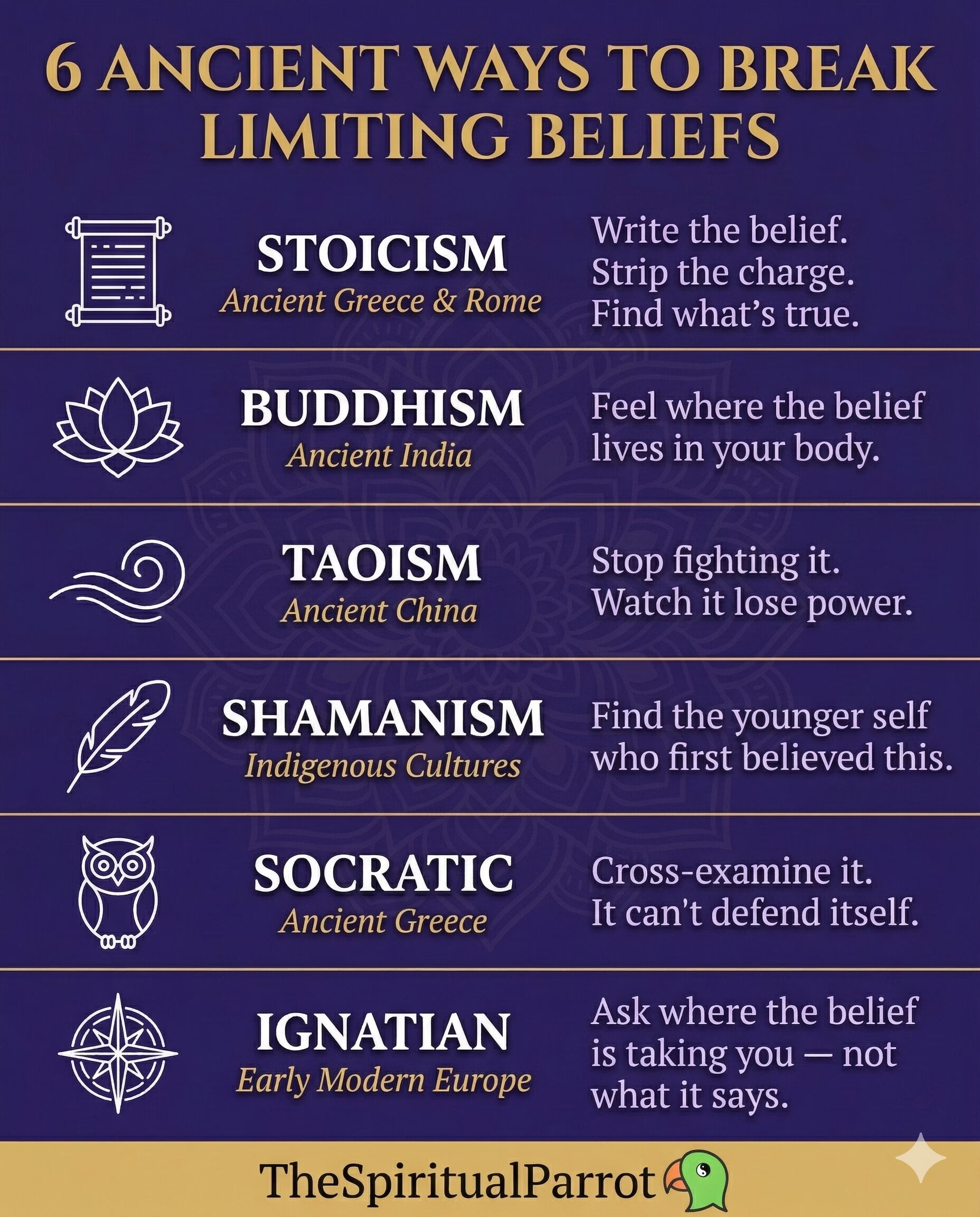
1. The Stoic Practice of Examining Impressions
The Stoics were obsessed with one question: is this thought actually true?
Not “does this thought feel true” — they understood that feelings of certainty are notoriously unreliable guides to actual truth. The question was: when examined carefully, rationally, and honestly, does this belief hold up?
Marcus Aurelius — Roman emperor and practicing Stoic — wrote extensively in his private journals about the discipline of testing every impression before accepting it. His method was blunt: take the belief that is troubling you, strip away the emotional charge, and look at what remains. Is there genuine evidence for it? Or is it a story assembled from fear, old wounds, and habit?

The practice he recommended was to describe the thing you fear or believe as plainly as possible. If you believe you are not talented enough to succeed, write it down in the most literal, concrete terms. Not “I’ll never make it” — but: “I have not yet developed the specific skills required for this goal.” That second version is something you can act on. The first is a verdict. The Stoics were ruthless about the difference.
This reframing technique is one of the most time-tested ways to break limiting beliefs through reason alone — and it costs nothing but honesty.
How to Practice
Take one limiting belief you hold about yourself. Write it down exactly as it sounds in your head. Then rewrite it three times, each time making it more specific, more literal, and less absolute. Watch how the belief changes shape as you force it out of generalization and into precision. A belief that cannot survive specificity was never entirely true to begin with.
2. Buddhist Inquiry — Tracing the Belief to Its Root
Where Stoicism works at the level of rational examination, Buddhist practice goes further — into the ground from which the belief grows.
The method is called Vipassana, or insight meditation. Within it, there is a specific inquiry technique — used extensively in traditions descended from the Thai Forest school — that is particularly useful for anyone seeking to break limiting beliefs at their root.
The practice is simple in structure and demanding in application. You sit quietly, bring the limiting belief to mind deliberately, and then watch what happens in the body. Not the story. Not the thoughts that cluster around it. The raw physical sensation that the belief produces — where it lives in the body, what texture it has, whether it is hot or cold, tight or expansive, moving or still.
Ancient Buddhist teachers taught that every mental formation has a physical correlate. The belief “I am not enough” doesn’t just exist as an idea — it lives as a contraction in the chest, a heaviness in the stomach, a hollowness behind the sternum. When you locate it physically and observe it without trying to change it, something begins to shift. The sensation starts to move.
This is not the same as positive thinking. It is more like surgery — and it is one of the most effective ancient methods to break limiting beliefs that cognitive approaches often can’t reach alone.
How to Practice
Sit quietly for five minutes to settle the mind. Then deliberately call up the limiting belief — say it internally, clearly. Immediately drop your attention into the body. Where do you feel this belief physically? Place your full attention there. Do not try to fix, release, or change it. Simply observe it the way you would watch clouds — with steady, patient, non-interfering attention. Most people find that within five to ten minutes, something in the sensation softens. That softening is real change at the level where the belief actually lives.
3. The Taoist Principle of Wu Wei — Stopping the War With Yourself
One of the most counterintuitive contributions the ancient world makes to the project of breaking limiting beliefs comes from Taoism — and it involves doing considerably less, not more.
Wu Wei is one of the central principles of Taoist philosophy, often translated as “non-action” or “effortless action.” It does not mean passivity. It means ceasing to force outcomes that are resisted by the natural flow of things — and in the context of inner work, it means something radical: that the struggle to fix yourself may be part of what keeps you stuck.
Consider how most people approach limiting beliefs. They identify a belief they don’t want. They fight it. They argue with it. They try to overwrite it. They feel frustrated when it returns. They try harder. The Taoist observation is that this fighting stance — this constant inner warfare — actually reinforces the pattern it is trying to dissolve. What you resist, you keep alive. What you observe with genuine equanimity begins to lose its power on its own.
Laozi wrote in the Tao Te Ching: “To the mind that is still, the whole universe surrenders.” This is a precise description of what happens when you stop feeding a mental pattern with the energy of resistance. The pattern, deprived of conflict, begins to settle.
How to Practice
The next time a limiting belief arises — in the middle of a task, in conversation, in the quiet before sleep — try this instead of fighting it: acknowledge it by name. “There is the belief that I’m not good enough.” Then return to whatever you were doing. Do not give it additional attention, argument, or energy. This simple practice, done consistently, is one of the most effective ways to break limiting beliefs that direct confrontation often fails to shift. The Taoists understood what we keep forgetting: not every knot comes undone by pulling harder.
4. Shamanic Soul Retrieval — Recovering What Was Lost
Every shamanic tradition on earth — from the Siberian steppes to the Peruvian Amazon to the indigenous cultures of North America — arrived independently at the same understanding: that psychological wounding causes a fragmentation of the self.
When something overwhelming happens to us — especially in childhood, before we have the capacity to process it — a piece of the self splits off and goes into hiding. In shamanic terms, this is called soul loss. In modern psychological language, we might call it dissociation, or the formation of a wounded inner child. The labels differ. The phenomenon they describe is remarkably consistent.
What this has to do with limiting beliefs is direct: many of the deepest, most stubborn beliefs we carry were formed in those moments of overwhelm. They weren’t adopted logically. They were absorbed by a self that was too young and too frightened to evaluate them critically. This is precisely why so many people find it difficult to break limiting beliefs through willpower or logic alone — the belief was never formed that way.
Shamanic soul retrieval works by journeying into the non-ordinary realms where these split-off parts reside and inviting them back. What makes this one of the more profound ancient approaches to break limiting beliefs is that it works at the level of the original wound rather than the belief it produced.
How to Practice (Adapted)
Sit quietly and close your eyes. Bring to mind a limiting belief you have carried for a long time. Ask yourself: how old does this feel? When did I first believe this about myself? Let an image or memory arise — not to be analyzed, but to be witnessed. If you can sense a younger version of yourself in that memory, simply be present with them. Offer what they needed then and didn’t receive: acknowledgment, safety, the understanding that what happened was not their fault. This practice takes time. It is not a one-session fix. But it reaches places that affirmations and cognitive reframing genuinely cannot.
5. Socratic Dialogue — The Ancient Greek Art of Questioning Everything
Socrates famously claimed to know nothing. This was not false modesty. It was a method.
The Socratic method is a structured process of questioning that exposes the hidden assumptions underlying any belief. Socrates would take a statement held with great confidence and ask, simply: how do you know that? What is your evidence? What would have to be true for that to be false? Have you considered the opposite?
The goal was not to win an argument. It was to reach what the Greeks called aporia — productive uncertainty, where a belief held with false confidence is revealed to be considerably less solid than it appeared. This moment of honest uncertainty is not a defeat. In Socratic terms, it is the beginning of genuine understanding.
Most limiting beliefs, when subjected to honest Socratic questioning, cannot actually defend themselves. They are built on selective memory, emotional reasoning, and the unchallenged authority we grant to our own worst moments. They have simply never been seriously cross-examined.
How to Practice
Write your limiting belief at the top of a page. Then answer these five questions honestly. One: what is my actual evidence for this belief? Two: what evidence exists against it? Three: am I applying a standard to myself I would never apply to someone I love? Four: what is the worst realistic outcome if this belief were partially true? Five: what becomes possible if this belief is wrong? Do this in writing, not just in your head. The page holds you accountable in ways that thought alone does not.
6. Ignatian Discernment — Listening Beneath the Noise
This one comes from an unexpected corner of the ancient world: the spiritual exercises developed by Ignatius of Loyola in 16th-century Spain, rooted in centuries of earlier Christian contemplative tradition.
Ignatian discernment is a practice of deep interior listening designed to distinguish between movements that lead toward life and wholeness (what Ignatius called consolation) and movements that lead away from them (desolation). In the context of limiting beliefs, it offers a tool that neither Stoicism nor Buddhism quite provides: a way of evaluating beliefs not just by their logical content but by what they produce in the soul.
The practice asks: when you hold this belief, where does it take you? Does it open you or close you? Does it expand your sense of what is possible, or contract it? Ignatius taught that the voice of genuine truth tends to be quiet, steady, and oriented toward life. The voice of a limiting belief, by contrast, tends to be urgent, absolute, and oriented toward constriction. Learning to tell the difference is one of the most underrated skills a person can develop.
How to Practice
Hold your limiting belief in mind for a few quiet minutes. Then ask yourself: where does this belief want to take me? Not what does it say — but where does it lead? Toward engagement or withdrawal? Toward courage or avoidance? Toward compassion for yourself or contempt? The direction a belief points you is often more revealing than its content.
The direction a belief wants to take you is one of the clearest signs of whether it deserves your continued loyalty.
Putting the Ancient Toolkit Together
The six approaches in this article are not in competition with each other. They work at different depths and through different mechanisms, and the most effective personal growth work draws from more than one tradition.
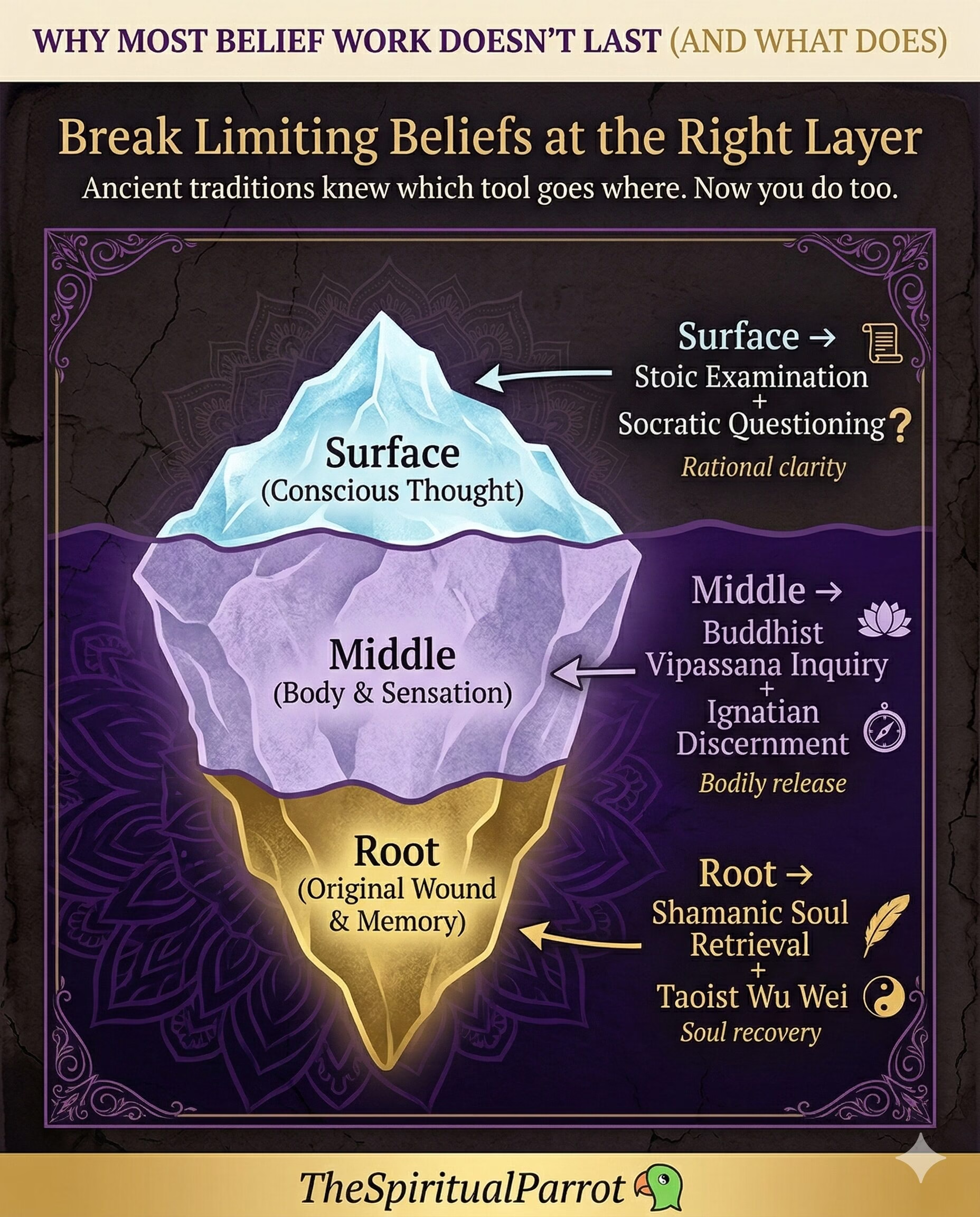
If you are at the beginning of this work, start with the Stoic practice of examining impressions — accessible, concrete, and immediately applicable. Once you have identified the beliefs most worth addressing, add the Buddhist body-based inquiry to locate where they actually live. Use the Taoist principle of Wu Wei to stop feeding them with unnecessary resistance. When you encounter beliefs that feel older and deeper than rational examination can reach, the shamanic inner child approach will take you there. The Socratic method is your ongoing maintenance tool. Ignatian discernment gives you a compass for real-time evaluation.
To break limiting beliefs at the level where they actually operate — not just at the surface, but in the body, in memory, in the deep grooves of the mind — requires patience, honesty, and a willingness to look where it is uncomfortable to look. Most people who struggle to break limiting beliefs for good are working at the wrong layer. The ancient traditions didn’t make that mistake.
The question is not whether these tools work. They have been tested across thousands of years and millions of lives. The question is whether you will pick them up — and whether you will stay with them long enough to find out what is waiting on the other side of the stories you’ve been telling yourself.