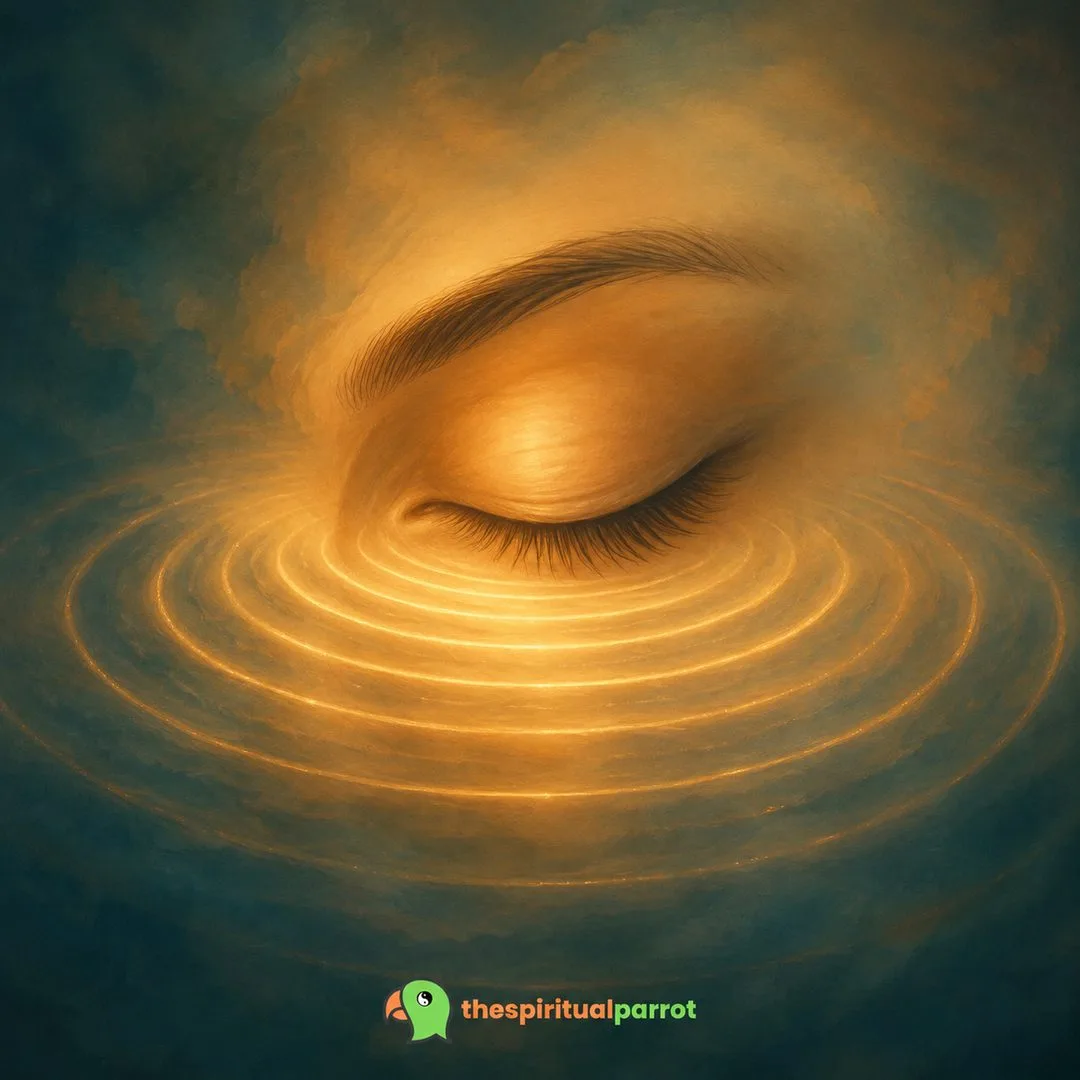
It starts as a flutter under the eyelid that nobody else can see. Then it happens again the next day, and you find yourself wondering whether it means something.
Almost every culture has an answer, and the interesting part is that they disagree with each other — sometimes completely. That disagreement is worth understanding, because it tells you how to read the sign honestly rather than just picking the interpretation you prefer.
One practical note first: persistent eyelid twitching is usually myokymia, a harmless muscle spasm caused by stress, tiredness, caffeine or eye strain. It almost always passes. If it spreads to the rest of your face, forces the eye fully closed, or lasts more than a few weeks, see a doctor. Everything below sits alongside that, not instead of it.
Why the Eye Carries Meaning
Across nearly every tradition, the eye is treated as the boundary between inner and outer — the organ of perception, insight and truth. That is why “seeing” and “knowing” share vocabulary in most languages.
So an eye acting on its own, without your instruction, gets read as perception trying to tell you something. Traditional systems then split the meaning by side, because left and right carry opposite associations in most symbolic systems: left with the receptive, intuitive and feminine; right with the active, outward and masculine.
That split is why interpretations reverse depending on which eye is involved, and why some traditions reverse them again depending on whether you are a man or a woman.
Left Eye Twitching: Traditional Meanings
1. Incoming news you have not been told yet. The most widespread reading of a left eye twitch is that information is on its way — often about someone at a distance.
2. Someone is speaking about you. Many folk traditions read the left eye as a sign of being discussed elsewhere, though not necessarily unkindly.
3. Grief or unwelcome news, in Western folklore. European superstition is the least charitable, linking the left eye to bad tidings. Worth noting this reading is not shared by most other traditions.
4. Good fortune for women, in South Asian tradition. In much of India, a twitching left eye is a favourable sign for women and an unfavourable one for men. The gender reversal is central to the system, and skipping it produces the wrong reading entirely.
5. Intuition surfacing. Because the left side is associated with the receptive and inward, a modern reading holds that a left twitch marks something you already sense but have not admitted.
Right Eye Twitching: Traditional Meanings
6. Good news arriving. The most common global reading, and the near-inverse of the left.
7. Success or recognition, for men in South Asian tradition. The right eye is favourable for men and cautionary for women — the mirror of the left-eye rule.
8. A visitor or reunion. Several traditions link the right eye to someone returning, or an unexpected meeting.
9. Action rather than reflection. Because the right side is associated with outward energy, the modern reading points at doing rather than waiting.
How the Meaning Changes by Culture
This is the part most articles skip, and it is the part that makes the sign useful rather than arbitrary.
South Asian tradition is the most systematic. The meaning depends on both the eye and the gender of the person, producing four distinct readings rather than two. Some regional systems also assign meanings to specific parts of the eye — upper lid, lower lid, corner.
Chinese tradition ties the reading to the time of day, in two-hour blocks. A twitch at dawn carries a different meaning from the same twitch at midnight, and the system is closer to a timetable than a simple left-right split.
Western folk belief is the simplest and the most pessimistic: left for bad, right for good, with no gender or timing element.
African and Caribbean traditions vary considerably, with several linking eye twitching to an impending visitor or to news of a birth.
The honest conclusion from that spread is that no single interpretation is authoritative. What is consistent across all of them is the underlying instruction: something is asking for your attention. What it is, only your own situation can say.
Reading Your Own Pattern
Because the traditions conflict, the useful practice is to build your own record rather than adopting someone else’s system.
Keep a note on your phone. When it twitches, write down three things: which eye, the time, and what you were thinking about in the ten seconds before.
After a few weeks a personal pattern usually appears, and it is almost always more specific than any inherited meaning. Most people find their twitching clusters around one situation — a particular person, an avoided decision, or a recurring stress. That correlation is the message, whether you read it as spiritual or simply as your body reporting tension you had not noticed.
That approach also has the advantage of being honest. It does not require the folklore to be literally predictive; it just uses the twitch as a prompt to look at what is going on.
When It Is Simply Your Body
Being straightforward about this protects the practice rather than undermining it.
The overwhelming majority of eyelid twitching is myokymia, and its common causes are unglamorous: too little sleep, too much caffeine, screen strain, dry eyes, magnesium deficiency, and stress. All of those respond to ordinary changes.
Interestingly, that overlaps with the traditional reading rather than contradicting it. If the sign says “something needs your attention,” and the cause is exhaustion and stress, the message has arrived accurately by an ordinary route.
Practical steps worth taking before anything else: more sleep, less caffeine, breaks from screens, and a genuine mindfulness practice if the stress is chronic. A regular daily meditation helps here for the same reason it helps most stress-driven symptoms.
See a doctor if the twitch involves more of your face, closes the eye completely, comes with drooping or redness, or persists beyond a few weeks.
Final Thought
An eye twitch is one of the few omens that comes with a built-in physical explanation, and that is worth sitting with rather than choosing between.
The traditions say pay attention. The medicine says you are tired and wound up. Those are not competing answers. They are the same answer arriving in different vocabulary.
Note which eye, note the time, note what you were thinking. Then get more sleep.