A migraine is not a bad headache. Anyone who has had one knows the difference: the visual disturbance beforehand, the nausea, the way ordinary daylight becomes unbearable, and the hours or days lost to a dark room.
Crystal practice for migraine is old, and its appeal is easy to understand. When you are lying in the dark unable to look at a screen, having something cool and smooth to hold against your head is a genuine comfort.
Before anything else: migraine is a neurological condition, not a lifestyle complaint. Effective treatments exist — triptans, CGRP inhibitors, preventive medication — and many people who assume nothing helps have simply never been properly treated. If migraines are costing you days, please see a doctor. Sudden severe headache unlike anything before, headache with fever or stiff neck, or headache after a head injury needs urgent medical attention.
Understanding Migraine
Migraine involves waves of altered brain activity affecting nerve signals, blood flow and chemistry. That is why it produces far more than pain: aura, nausea, light and sound sensitivity, and cognitive fog that can outlast the headache by a day.
Attacks often follow triggers, and the common ones are frustratingly ordinary — disrupted sleep, skipped meals, dehydration, hormonal shifts, weather changes, and stress. Notably, the stress trigger frequently fires on the release rather than the pressure, which is why weekend migraines are so common.
For any comfort practice, the thing that matters is what the body wants during an attack: darkness, quiet, stillness, cool. Every traditional crystal practice for migraine happens to deliver exactly those.
7 Crystals Traditionally Used
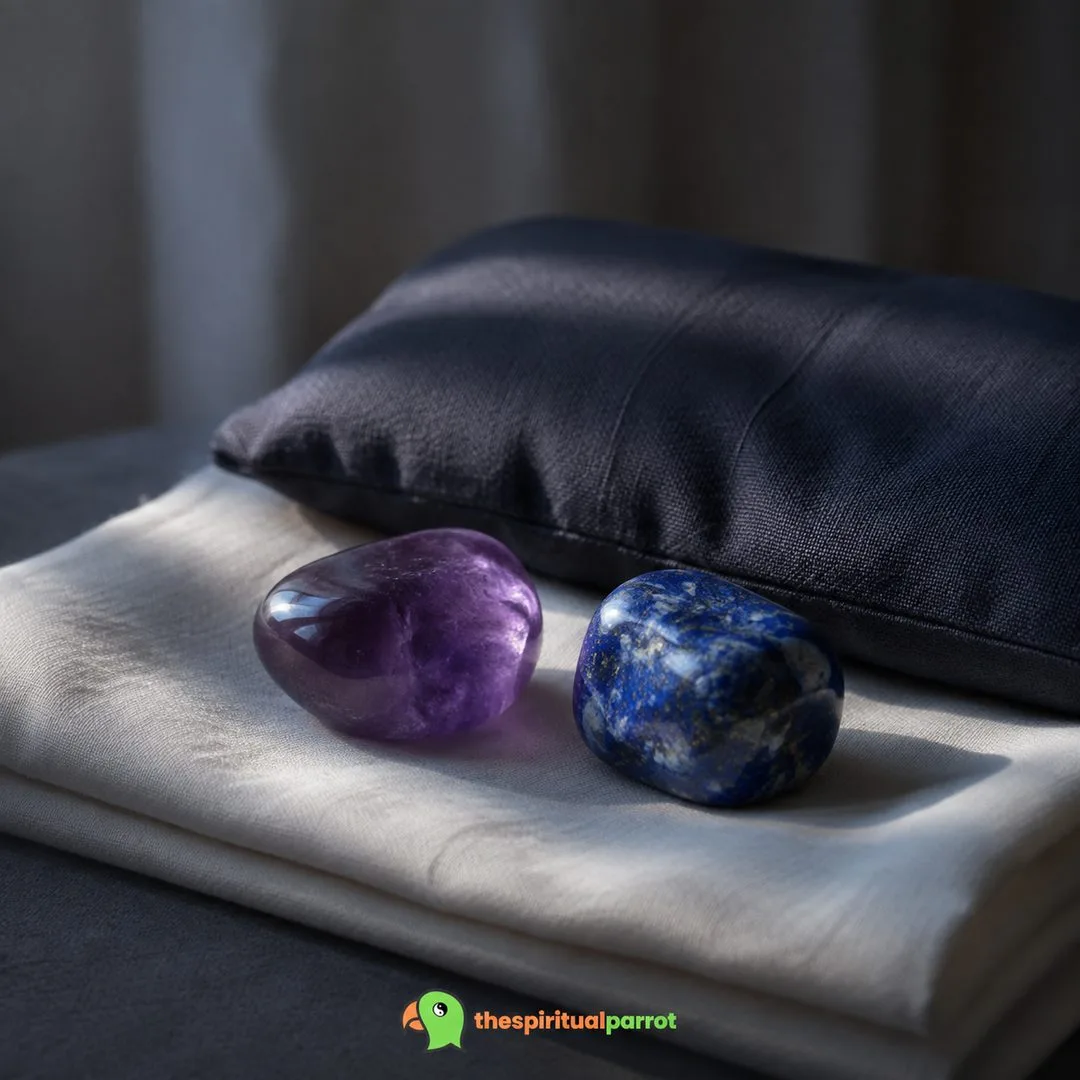
Amethyst is the primary stone for head pain across most traditions, linked to the crown chakra and to mental quiet. Its purple colour and cool surface make it the standard choice, and it is the one most people reach for first. Our amethyst guide covers its wider uses.
Lapis lazuli is the classic migraine stone specifically. Traditionally associated with the third eye and with relieving pressure behind the eyes, it has a long history in Egyptian and Mesopotamian practice for exactly this complaint.
Clear quartz is used as an amplifier and for general clearing, traditionally placed at the crown.
Howlite is the calming stone, used where migraines are stress-driven and where the aftermath leaves you unable to switch off.
Sugilite is the traditional stone for chronic pain generally, and one of the more commonly recommended for migraine specifically.
Blue lace agate is linked to cooling and to the throat, traditionally used where tension runs up the neck into the head — a very common migraine pattern.
Rose quartz is included for the emotional side: the frustration and guilt that come with cancelling plans repeatedly.
Using Them During an Attack
The practice is simple, which matters when you cannot think clearly.
Chill the stone first. Put it in the fridge, not the freezer. A cool smooth stone against the forehead or the back of the neck is genuinely soothing, and cold is one of the few non-drug interventions with real supporting evidence for migraine.
Dark room, flat, quiet. Lie down, lights off, phone elsewhere. Place amethyst or lapis on the forehead or third eye, and something at the base of the skull if the pain runs up the neck.
Breathe slowly and long on the exhale. Roughly twice as long out as in. Pain causes shallow breathing and jaw clenching, both of which worsen head tension. This is a real mechanism.
Do not try to meditate through it. During an acute attack, concentration practice is usually beyond reach and trying makes people feel worse for failing. Just hold the stone and breathe.
Between attacks is different. That is where a regular meditation practice has genuine value — mindfulness-based approaches have reasonable evidence for chronic pain, and stress reduction addresses one of the most common triggers.
Being Honest About the Evidence
There is no scientific evidence that crystals affect migraine through any energetic or vibrational mechanism. Studies of crystal healing consistently find that reported effects match placebo, with imitation stones performing identically.
What the practice actually delivers is real, though, and worth naming precisely: cold applied to the head, a dark quiet room, lying still, and slow breathing. Every one of those has genuine support for migraine relief. The stone is the reason you do them, and the reason you do them consistently.
That is not a small thing. Many people in an attack keep pushing through — staying at the screen, staying in the light — and the ritual is what gives them permission to stop.
The failure mode is using crystals instead of treatment. Migraine is one of the most treatable neurological conditions there is, and the gap between untreated and properly treated is measured in reclaimed weeks per year.
Caring for Your Stones
- Moonlight — safe for all of these
- Sound or smoke — traditional and gentle
- Avoid water with lapis lazuli and sugilite, both of which are porous
- Keep amethyst and rose quartz out of direct sunlight, as both fade
- Rinse and dry anything you have kept in the fridge before storing
Tracking Your Triggers
The single most useful thing you can do, and the stone can be the prompt for it.
Keep a migraine diary: date, time of onset, what you ate, how you slept, where you were in your cycle if relevant, and the weather. After two months a pattern usually emerges, and it is nearly always more specific than the general trigger lists.
That record also transforms a medical appointment. “I get migraines a lot” and “I get 11 a month, mostly two days before my period and after disrupted sleep” produce completely different conversations.
Final Thought
A stone will not stop a migraine. Cold, darkness, stillness and slow breathing genuinely help — and if a cool piece of amethyst is what gets you to lie down in the dark instead of pushing through another hour, it has done something useful.
Keep it beside the medication, not instead of it. And if you have never been properly treated for migraine, that is the single highest-value thing on this page.