
Three in the morning has a particular quality. The house is quiet, the problem you were managing fine at noon has become enormous, and the knowledge that you have to function tomorrow makes falling asleep harder still.
Crystal practice for sleep is old and widespread, and there is a reason it persists that has nothing to do with mineral properties: it gives you a bedtime ritual. Ritual is one of the few sleep interventions that genuinely works.
Worth saying upfront: chronic insomnia is a medical condition, and the most effective treatment is CBT-I — cognitive behavioural therapy for insomnia — which outperforms sleeping pills long-term. If you have been sleeping badly for more than a few weeks, ask your doctor about it. What follows sits alongside that.
Understanding Insomnia
Sleep is not something you do. It is something that happens when the conditions allow, which is why effort makes it worse. Trying to fall asleep is the single most reliable way to stay awake.
Two systems govern it. Sleep pressure builds the longer you have been awake. Your circadian rhythm sets when your body expects to sleep, cued mainly by light. Insomnia usually means one or both have been disrupted — too little daytime light, too much evening light, caffeine too late, an irregular schedule, or a nervous system still running on daytime settings at midnight.
That last one is where a crystal ritual has something to offer. Not by inducing sleep, but by marking a transition. Your body responds to consistent cues, and a repeated pre-sleep sequence becomes one.
7 Crystals Used for Sleep
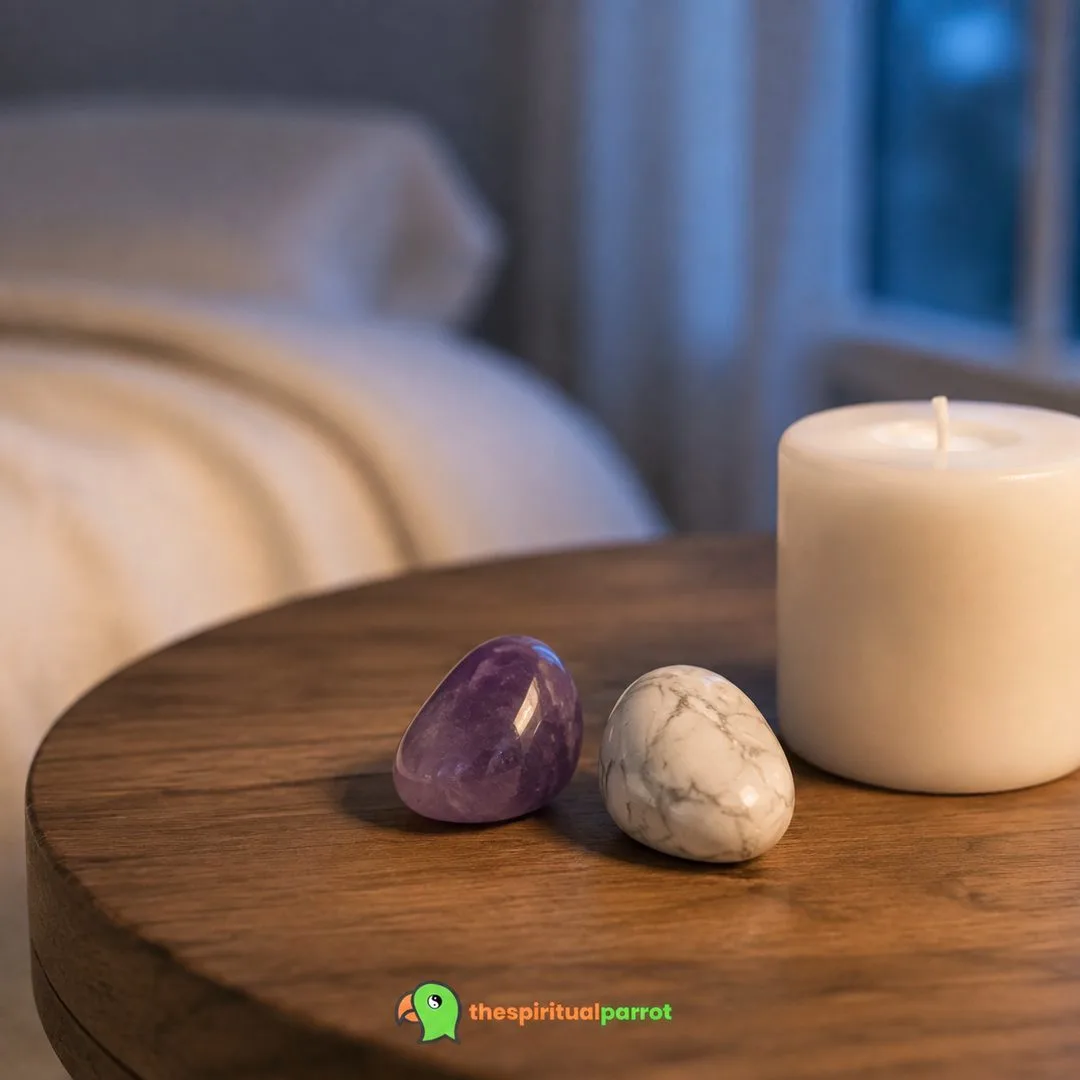
Amethyst is the classic. Traditionally placed under the pillow or on a bedside table, it is associated with mental quiet and with calming the crown chakra. It is the first stone most people try, and the one most report helps. Our amethyst guide covers its broader uses.
Howlite is the stone for the specific problem of a mind that will not stop talking. Its white marbled surface is traditionally linked to slowing racing thought, and it is the usual recommendation for people who lie down and immediately begin replaying the day.
Selenite is associated with clearing and with a calm bedroom atmosphere. A selenite lamp or wand on the windowsill is common practice. Note that selenite is water-soluble and must never be washed.
Lepidolite contains natural lithium and carries a long association with mood steadiness. Traditionally used where sleeplessness comes from anxiety rather than from a disrupted schedule.
Moonstone is linked to lunar cycles and to gentle rest, and is a traditional choice for people whose sleep worsens around the full moon.
Celestite is the softest of the group in feel and reputation, associated with peace and used where grief or sadness is keeping you awake.
Smoky quartz is the grounding stone of the set, traditionally used for nightmares and for waking in the small hours.
Where to Put Them
Placement is the part people ask about most, and traditional practice is fairly consistent.
Under the pillow — the classic for amethyst and howlite. Use a small tumbled stone. A large raw point under your head is uncomfortable and will wake you, which rather defeats the purpose.
On the bedside table — the most practical option, and the one most people settle into. Within reach if you wake.
On the windowsill — selenite here, traditionally to clear the room’s atmosphere and to catch moonlight.
Under the bed — smoky quartz or black tourmaline, traditionally for grounding and for nightmares.
Held in the hand — the most useful for actively falling asleep, because it gives your attention somewhere to go that is not tomorrow’s problems.
A Bedtime Ritual That Works
This is where the real value sits, so build it properly.
Ninety minutes before bed, phone out of the bedroom. This is the single highest-impact change on the list and the one people resist most. Charge it in another room and buy a cheap alarm clock.
Thirty minutes before, dim the lights. Bright overhead light suppresses melatonin. Lamps only.
Ten minutes before, sit on the edge of the bed with your stone and do nothing else. Breathe slowly, extending the exhale to roughly twice the inhale. This is not mystical — extended exhalation genuinely shifts the nervous system toward rest.
In bed, hold the stone and focus on its temperature and weight. When your mind returns to the day, return to the stone. This is a concentration practice, and it works the same way a guided meditation does.
If you are awake after twenty minutes, get up. Go to another room, keep the lights low, do something dull, return when sleepy. Lying in bed frustrated teaches your brain that bed is a place for frustration. This is the core of CBT-I and it matters more than every stone on this list.
Being Honest About This
There is no scientific evidence that crystals affect sleep through vibrational or energetic means. Blind studies find that people report identical benefits from fake stones, which tells you the effect is coming from expectation and ritual rather than the mineral.
I would rather say that plainly than have you discover it later and distrust everything else here.
But do not throw the practice out with the mechanism. A consistent, calming, screen-free wind-down sequence is one of the best-supported sleep interventions there is. If a stone is what makes that sequence happen every night — if it is the object that reminds you to sit down and breathe instead of scrolling — then it is doing real work by an ordinary route.
The failure mode is buying an amethyst, putting it under the pillow, changing nothing else, and expecting results. That will not work, and it is what leaves people concluding crystals are worthless.
Caring for Your Stones
- Moonlight — safe for all of them, and traditionally apt for sleep stones
- Sound — a bell or bowl
- Smoke — sage, palo santo or incense
- Never use water on selenite; it dissolves
- Keep amethyst out of direct sunlight, as it fades
Final Thought
The stone under your pillow will not put you to sleep. The routine you built around it might.
Take the ritual seriously and the mineral lightly. Phone out of the room, lights down, ten quiet minutes, same time every night. Hold the amethyst while you do it, and let it become the object that means the day is over.
And if you have been sleeping badly for months, ask your doctor about CBT-I. It is the thing that actually fixes this, and far too few people are offered it.